Two Tone / 17 products
Audio interfaces & recorders
USB and Thunderbolt interfaces, desktop mixers and multitrack recorders.
In stock · Free UK delivery. Online ordering opens soon.
1–17 of 17 products
Solid State Logic
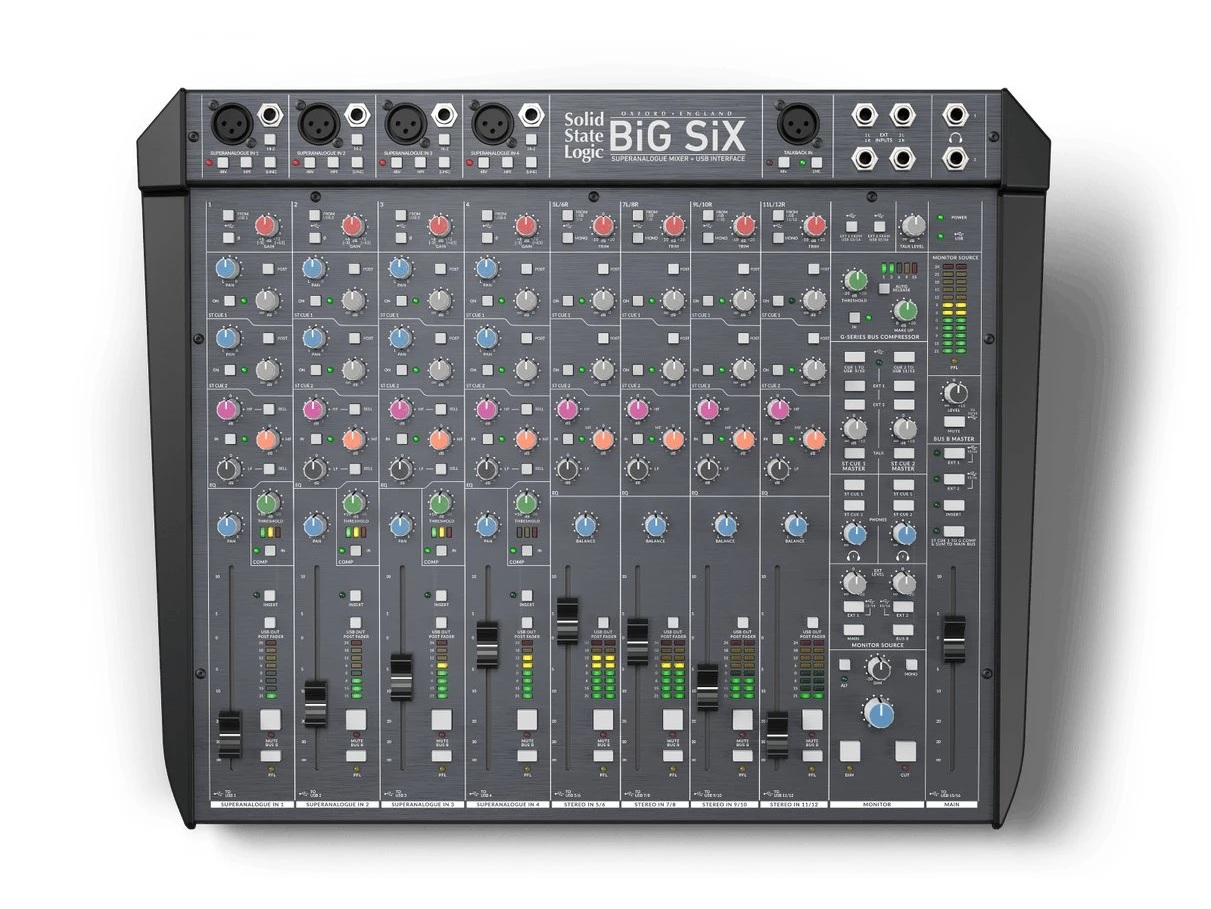
Solid State Logic BiG SiX Desktop Mixer
Four SuperAnalogue mic preamps
The Solid State Logic BiG SiX is an analogue desktop mixer with an integrated USB audio interface for recording, summing and monitoring. Four mono channels provide SuperAnalogue microphone preamps, while four stereo input channels handle additional line-level sources. The stereo channels are not four extra microphone preamps, and the mixer must not be confused with the smaller SSL SiX. BiG SiX incorporates three-band E-Series channel EQ, channel compression on the mono input paths and a G-Series bus compressor on the main mix. SSL describes sixteen channels of USB conversion for computer integration. These routing and conversion capabilities do not mean sixteen physical microphone inputs. Its two independent headphone outputs and monitor routing support different listening feeds without making the connected headphones or speakers part of this listing. The controls and analogue connections make it suitable for combining microphones, instruments and playback sources with a compatible recording system. A computer and appropriate software are needed for computer-based recording; microphones, headphones and speakers are separate requirements. The product photographs show the mixer from several angles, while the separate mounting-hardware image has been removed from the gallery. This listing is BiG SiX, not a software-only mixer or a standalone multitrack recorder.
Universal Audio
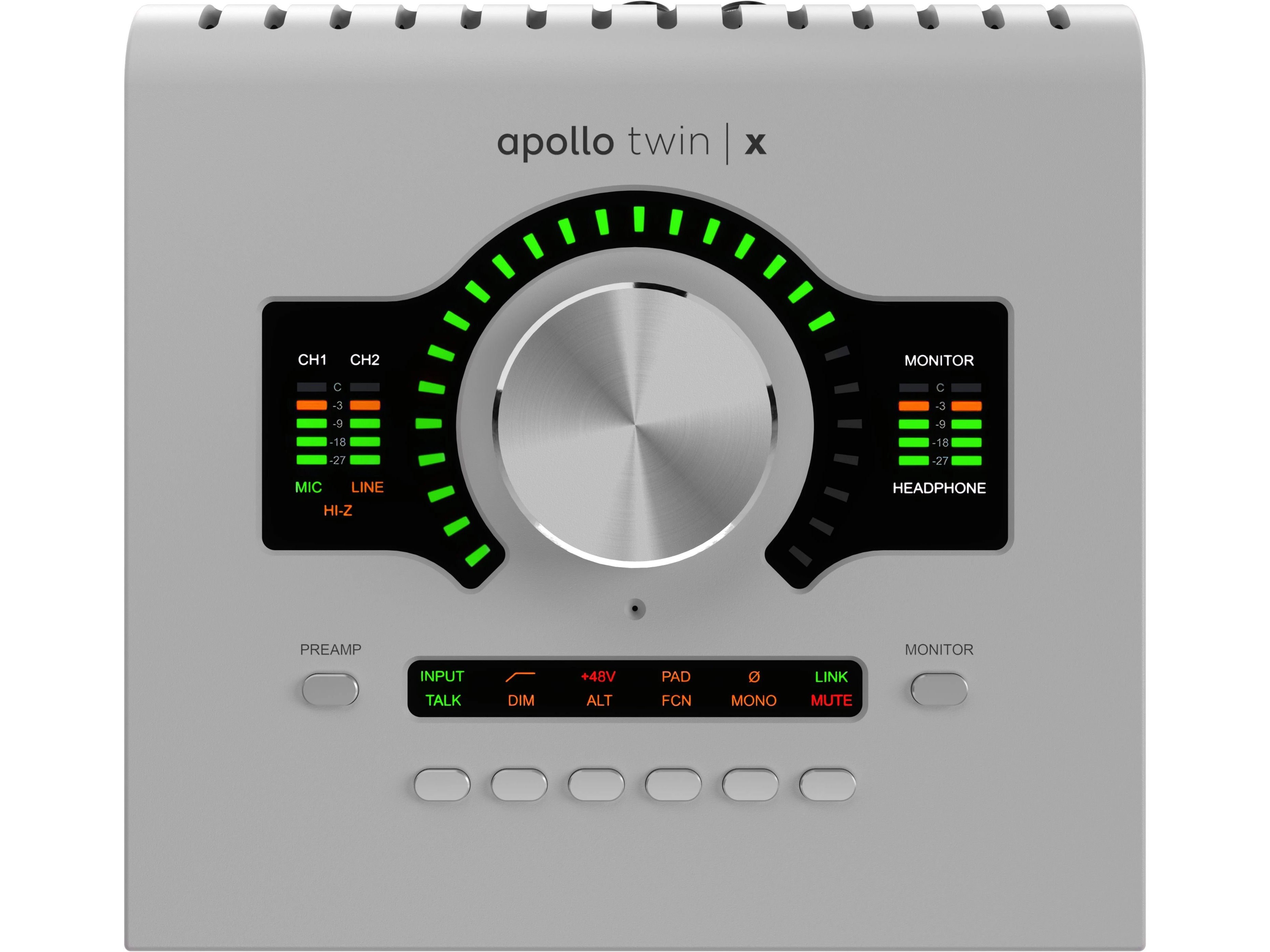
Universal Audio Apollo Twin X DUO Gen 2 Thunderbolt Audio Interface, UAD Analog Classics
10-in/6-out Thunderbolt interface
The Universal Audio Apollo Twin X DUO Gen 2 is a 10-in/6-out Thunderbolt desktop audio interface with built-in DUO Core DSP, supplied here with the UAD Analog Classics plug-in bundle. Its two Unison mic preamps take on the tone and response of classic analogue preamps from makers such as Neve, API and Manley when used with Unison plug-ins, and the onboard DSP lets you record through UAD plug-ins in real time. A front-panel Hi-Z input accepts guitar or bass, and an optical Toslink input adds ADAT or S/PDIF channels. On the rear are two 1/4" monitor outputs and two 1/4" line outputs that can be used as an alternate speaker pair, with a 1/4" TRS headphone output on the front. Apollo X Gen 2 conversion runs at up to 24-bit/192kHz, and Universal Audio quotes 129dB of dynamic range on the D/A. The updated UAD Console app adds Auto-Gain, Plug-In Scenes, bass management for a subwoofer and immersive audio support, and Apollo Monitor Correction by Sonarworks can calibrate the monitor and headphone outputs. A Thunderbolt-equipped computer is required.
Solid State Logic
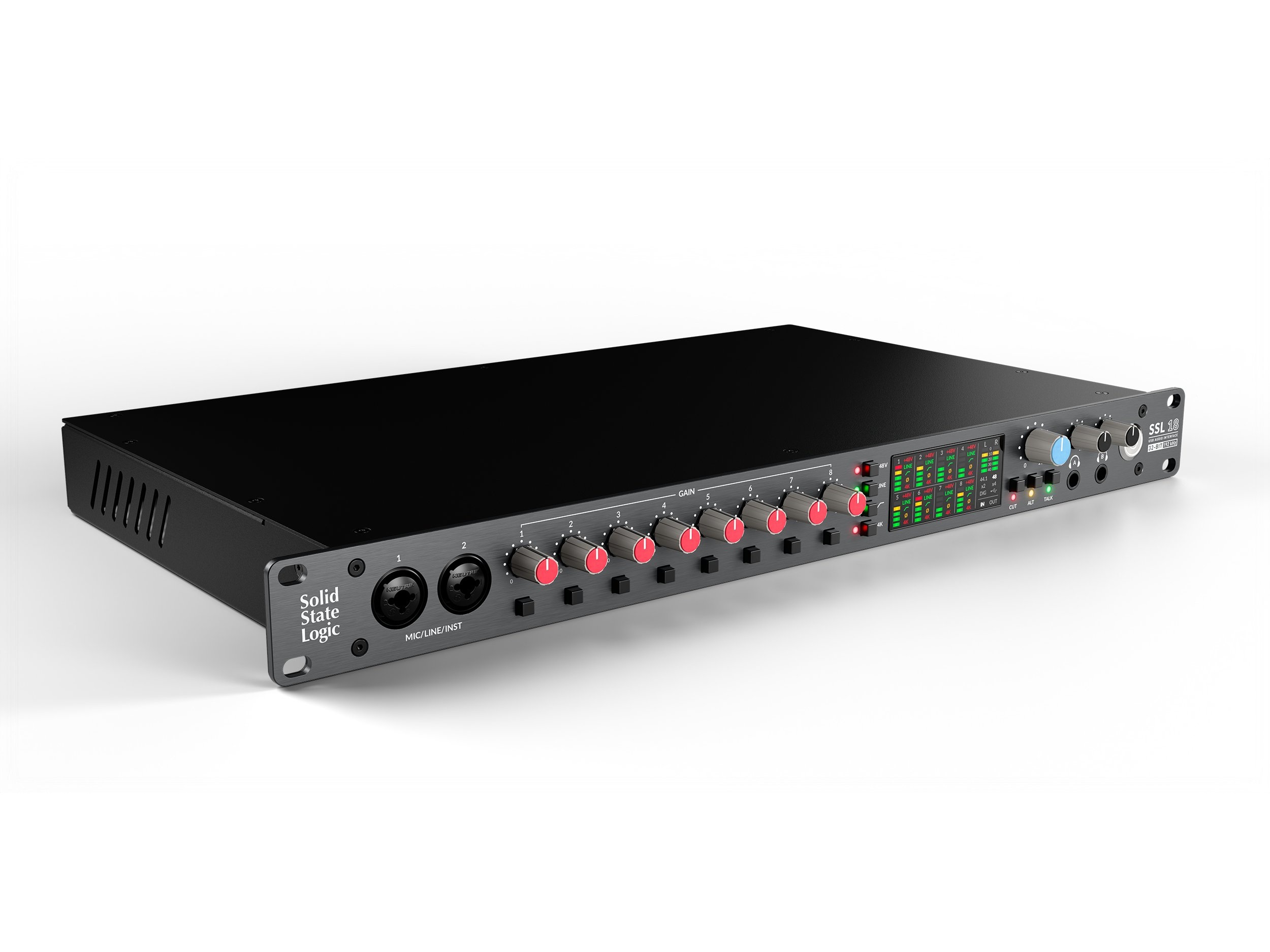
SSL 18 USB Audio Interface
Eight SSL-designed analogue preamps
The Solid State Logic SSL 18 is a rackmount USB audio interface designed for recording and monitoring with a compatible computer. Eight SSL-designed analogue preamps provide the core recording inputs, with selectable Legacy 4K analogue enhancement. Its advertised 26-input, 28-output configuration also includes digital connections and should not be described as twenty-six analogue microphone inputs. The digital section provides up to sixteen channels of ADAT input and output, plus stereo S/PDIF input and output. Available ADAT channel counts depend on the sample rate and connected equipment. Ten balanced analogue outputs support studio routing, and the configurable monitor control can be assigned to appropriate outputs through SSL 360 software. SSL specifies next-generation 32-bit/192 kHz converters. Headphone monitoring, MIDI connections and stereo loopback add recording and production options. A dedicated talkback path features SSL’s Listen Mic Compressor; this does not mean that every microphone input has that compressor. External digital preamps, microphones, speakers and a computer are separate purchases. This interface is not a standalone multitrack recorder.
Audient
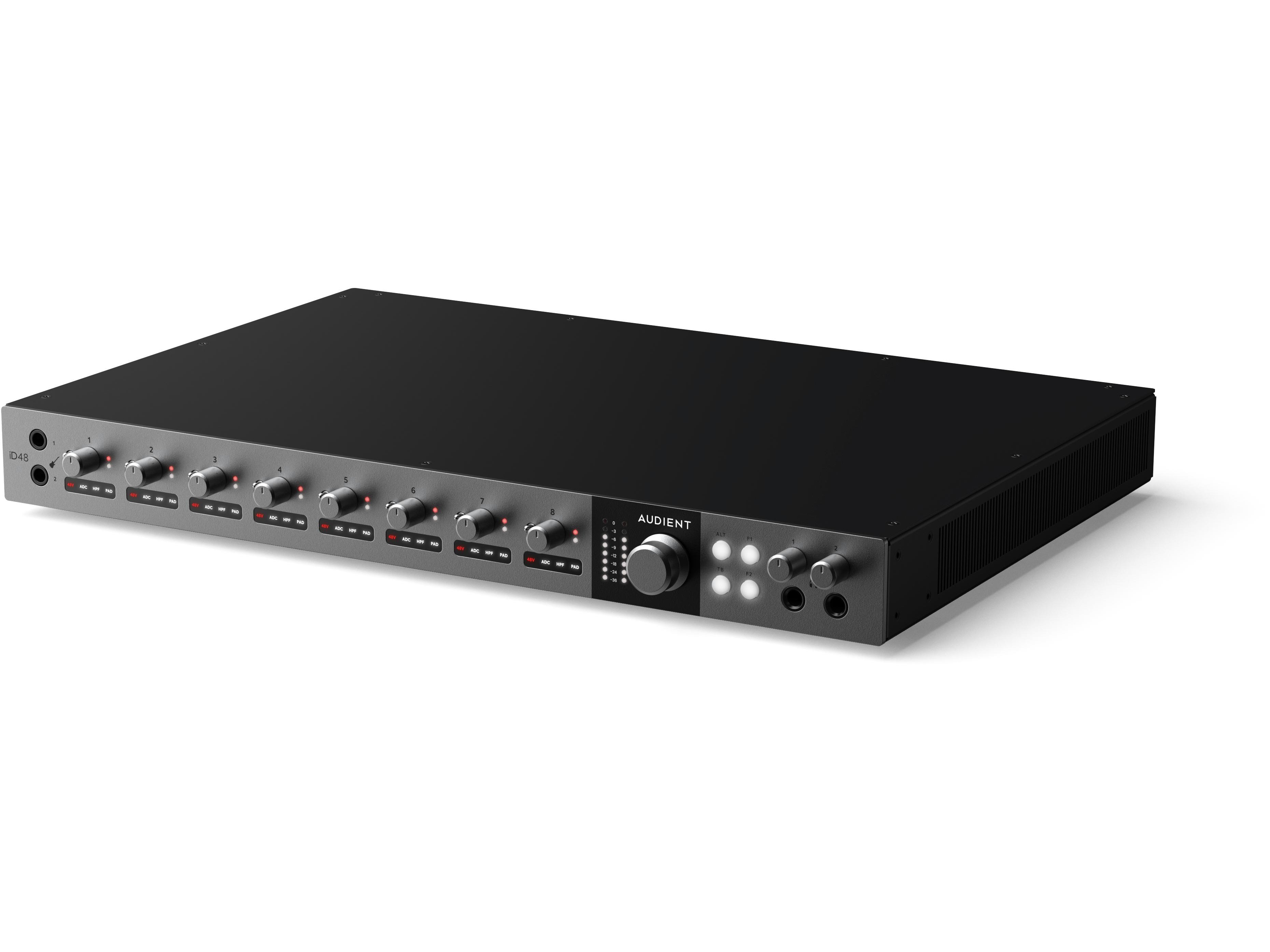
Audient iD48 24-in/32-out USB Audio Interface with 8 Console Mic Preamps
Eight Audient console mic preamps, up to 68dB gain
The Audient iD48 is the flagship of Audient's iD interface range, a rack-format USB audio interface that Audient describes as 24-in and 32-out. It suits project studios that record full bands, use outboard gear or need plenty of monitoring outputs. Eight Audient console microphone preamps sit on XLR and jack combo sockets, each offering up to sixty-eight decibels of gain including a ten-decibel gain boost, switchable forty-eight-volt phantom power, a ten-decibel pad and a hundred-hertz high-pass filter. Audient quotes an equivalent input noise of minus one hundred and twenty-seven dBu. Channels one and two also have front-panel instrument inputs for guitar or bass. The converters are specified at one hundred and twenty decibels A-weighted dynamic range on the inputs and up to one hundred and twenty-six and a half decibels A-weighted on the outputs, with operation up to ninety-six kilohertz. Digital expansion and multiple line and headphone outputs allow the channel count to grow with additional preamps. The 1U metal chassis arrives configured for desktop use, and rack ears are included for mounting in a nineteen-inch rack. Andertons lists the unit as 28 outputs; this listing follows Audient's own 32-output figure.
RME
RME Babyface Pro FS
Two XLR mic/line and two line/instrument inputs
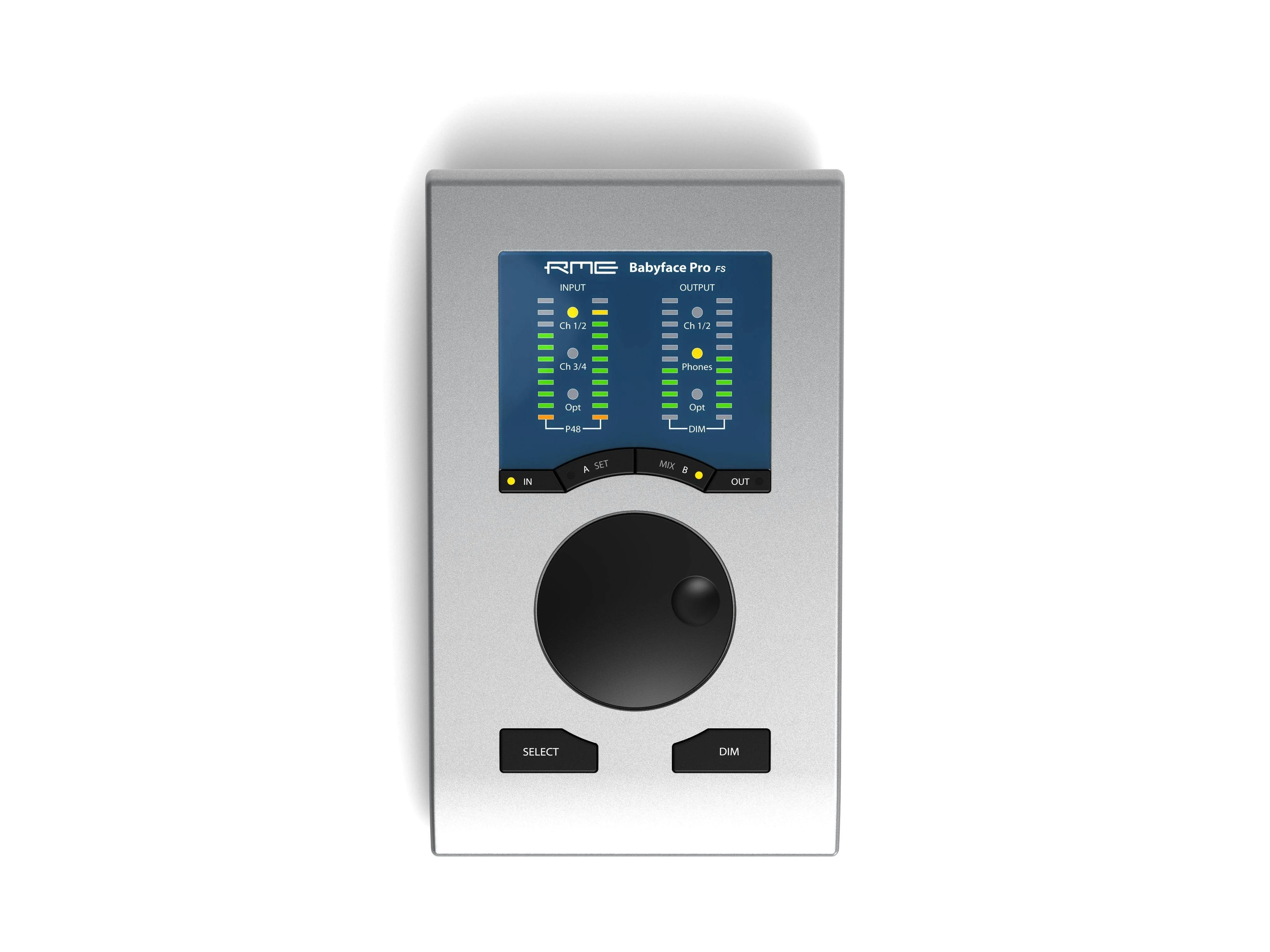
The RME Babyface Pro FS is a compact USB audio interface with an aluminium housing and physical controls for recording and monitoring. Two balanced XLR mic/line inputs are joined by two unbalanced line/instrument inputs, allowing microphones and instruments to be connected without treating the headline channel count as a count of microphone sockets. Balanced XLR main outputs feed monitoring equipment, while headphone connections provide personal listening. The computer connection uses USB 2.0, and supported operation extends up to 192 kHz. Its optical input and output can carry ADAT with SMUX support or S/PDIF, depending on the session configuration. RME’s twenty-four-channel headline combines input and output capacity and includes digital channels; the unit does not have twenty-four analogue inputs. TotalMix FX supports audio routing and monitor mixing, with onboard effects available in the monitoring workflow. The FS model includes SteadyClock FS and an output-level switch for the balanced main outputs. USB bus power supports portable use with suitable computer ports, while actual channel availability depends on sample rate and the connected digital equipment.
MOTU
MOTU UltraLite-mk5 USB Audio Interface
Two mic/line/instrument combo inputs
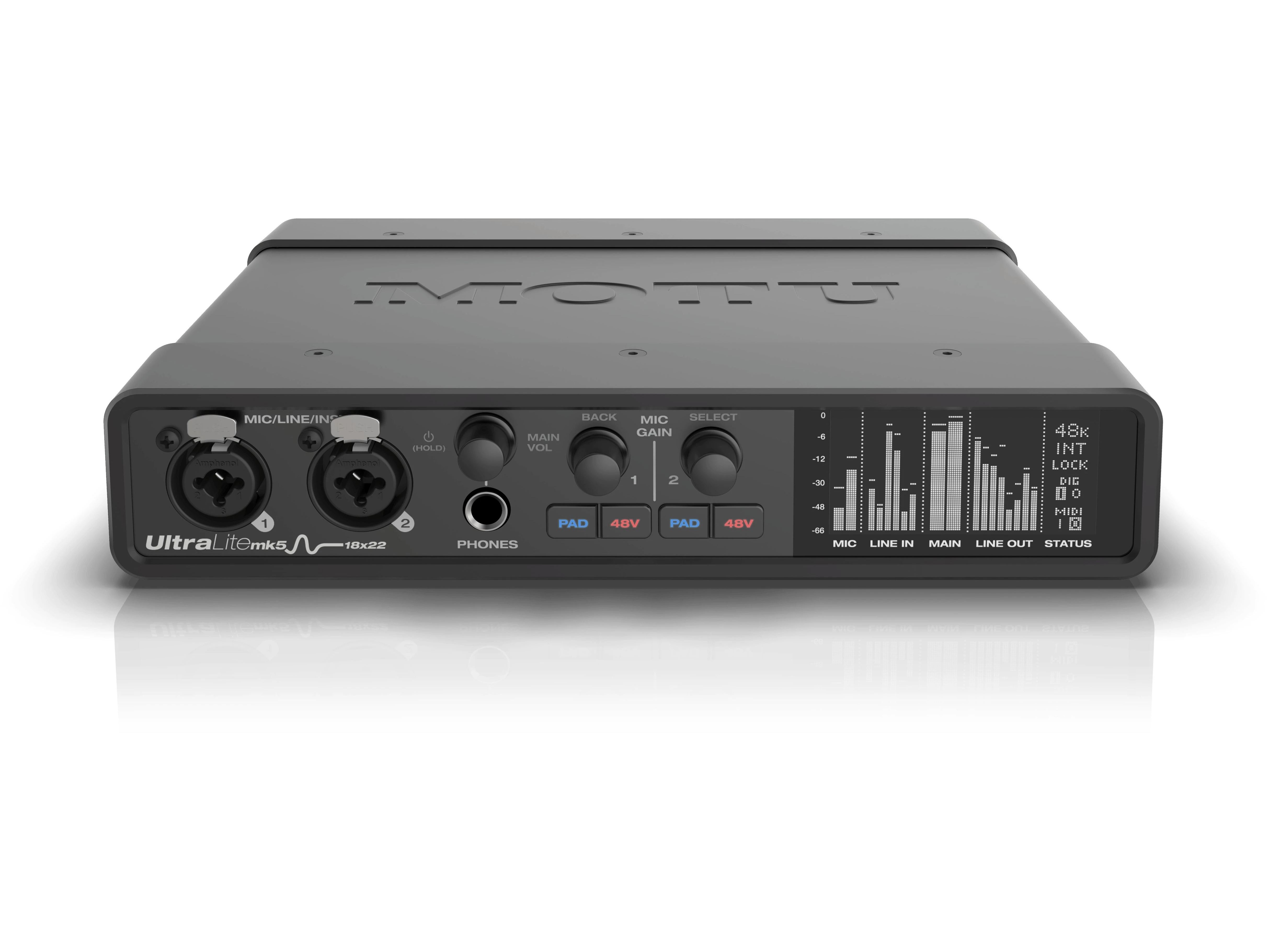
The MOTU UltraLite-mk5 is a compact USB audio interface with analogue and digital connections for recording, playback and monitor mixing. It provides two microphone, line or instrument combo inputs plus six balanced quarter-inch TRS line inputs. The advertised 18-input and 22-output totals include digital channels at standard sample rates; they do not mean eighteen microphone preamps or eighteen analogue inputs. MOTU specifies ten balanced TRS analogue outputs, a headphone output, optical digital I/O and S/PDIF connections. Available channel counts reduce at higher sample rates, so the full 18-in/22-out configuration should not be assumed at every recording setting. MIDI input and output connect compatible external MIDI equipment. The built-in DSP mixer provides EQ, compression and reverb for monitor mixes. Computer recording and playback still require a compatible system and software; the mixer is not a promise that every plug-in can run inside the interface. The unit uses its external power supply rather than relying on USB bus power. This is the mk5 model, not an earlier UltraLite generation. Microphones, instruments, loudspeakers and their signal cables are separate requirements, and the photographs show the interface itself rather than a complete studio.
Focusrite
Focusrite Scarlett 18i20 4th Gen 26-in/26-out Audio Interface
26-in/26-out, 24-bit/192kHz
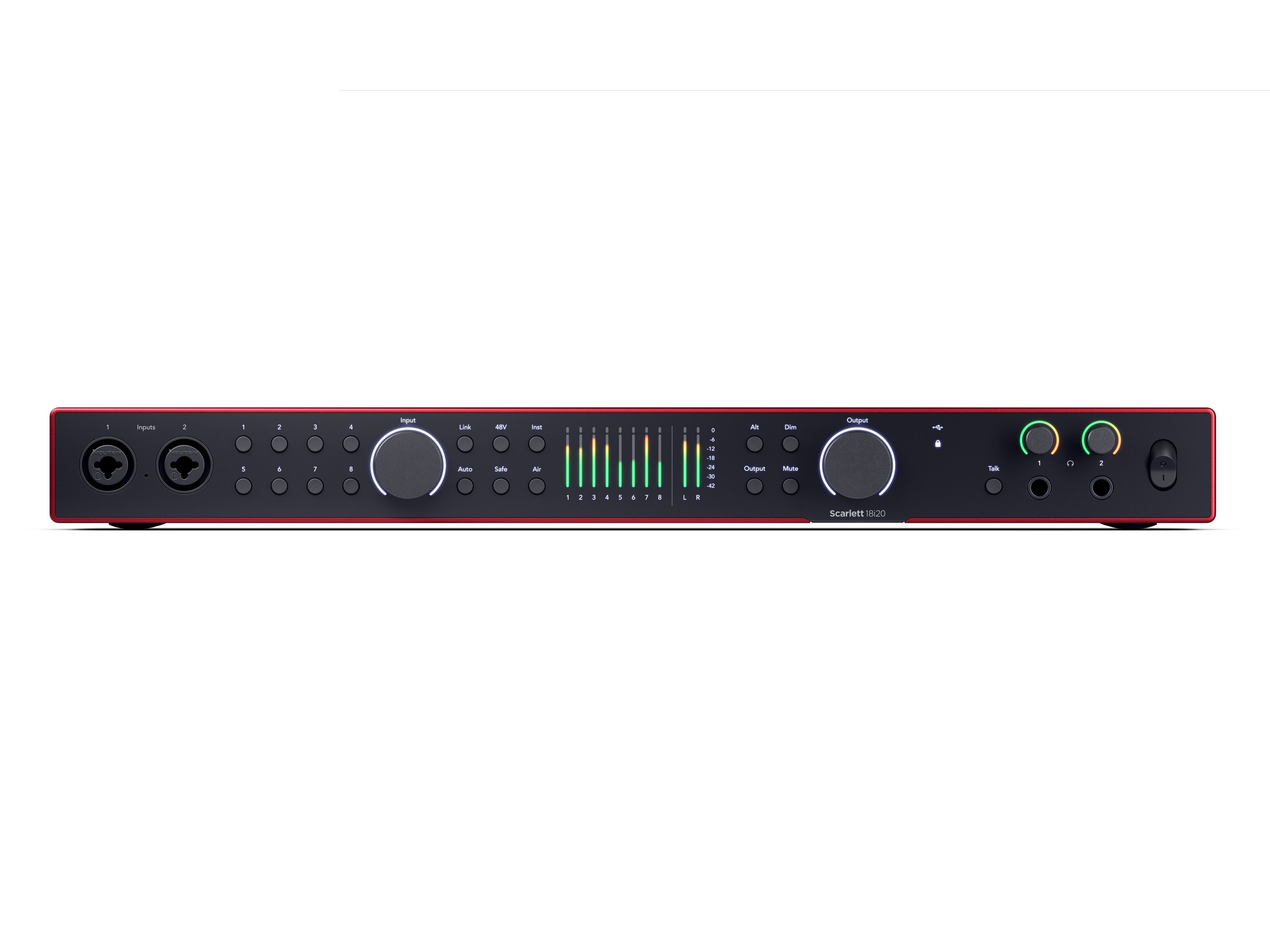
The Focusrite Scarlett 18i20 4th Gen is the largest interface in the current Scarlett range, a 1U rack-mountable USB interface with 26 simultaneous inputs and 26 outputs. It provides eight ultra-low-noise microphone preamps with sixty-nine decibels of gain range and an A-weighted equivalent input noise of minus one hundred and twenty-seven dBu. Two front-panel inputs accept microphones, line sources or instruments. Each preamp can be controlled remotely, and Auto Gain and Clip Safe help set levels and prevent clipping across all eight channels. Two Air modes, Presence and Presence with Harmonic Drive, add console-style character to vocals and guitars. Focusrite specifies a 122-decibel A-weighted dynamic range on the balanced line outputs and recording at up to 24-bit and 192 kilohertz. There are ten line outputs including alternative speaker switching, two headphone outputs and a built-in talkback microphone. Two ADAT inputs and outputs add up to sixteen channels at 44.1 or 48 kilohertz, alongside S/PDIF, MIDI and word clock connections. The unit uses an external power supply rather than USB bus power, measures 442 by 46.55 by 259.73mm and weighs 3.304kg. Focusrite's software bundle, including the Hitmaker Expansion, is included.
Universal Audio
Universal Audio Apollo Solo Heritage Edition — Thunderbolt 3
Two Unison microphone preamps
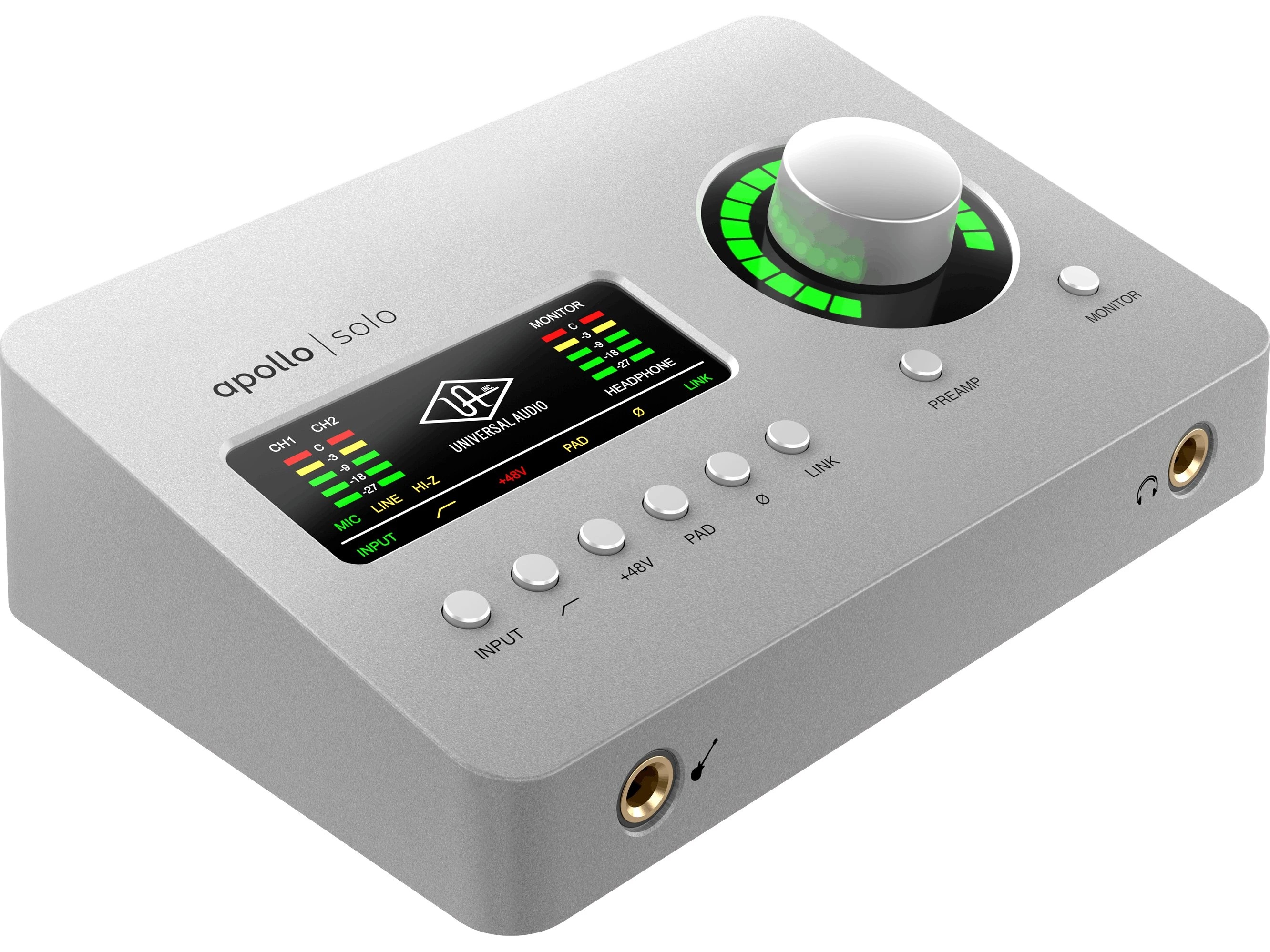
The Universal Audio Apollo Solo is a compact desktop recording interface for a compatible Thunderbolt-equipped computer. Two Unison microphone preamps support recording with compatible UAD preamp emulations, while onboard UAD processing allows supported effects to be used during tracking. Its two-input, four-output configuration includes headphone monitoring, and Universal Audio specifies conversion at up to 24-bit/192 kHz. This listing is the Thunderbolt 3 Heritage Edition, not the separate USB model. The rear connection and donor-bound barcode identify that version. A USB-C-shaped computer socket is not sufficient on its own: the host connection must support the required Thunderbolt capability. Universal Audio lists compatible Mac and Windows Thunderbolt 3 systems, and describes this model as powered through its Thunderbolt connection. The Thunderbolt 3 cable is sold separately. Software offers vary with eligible hardware, registration and the manufacturer’s current terms; no temporary promotional plug-in bundle is guaranteed here. Microphones, instruments, headphones and a computer are separate purchases. This is an audio interface rather than a standalone recorder.
RØDE
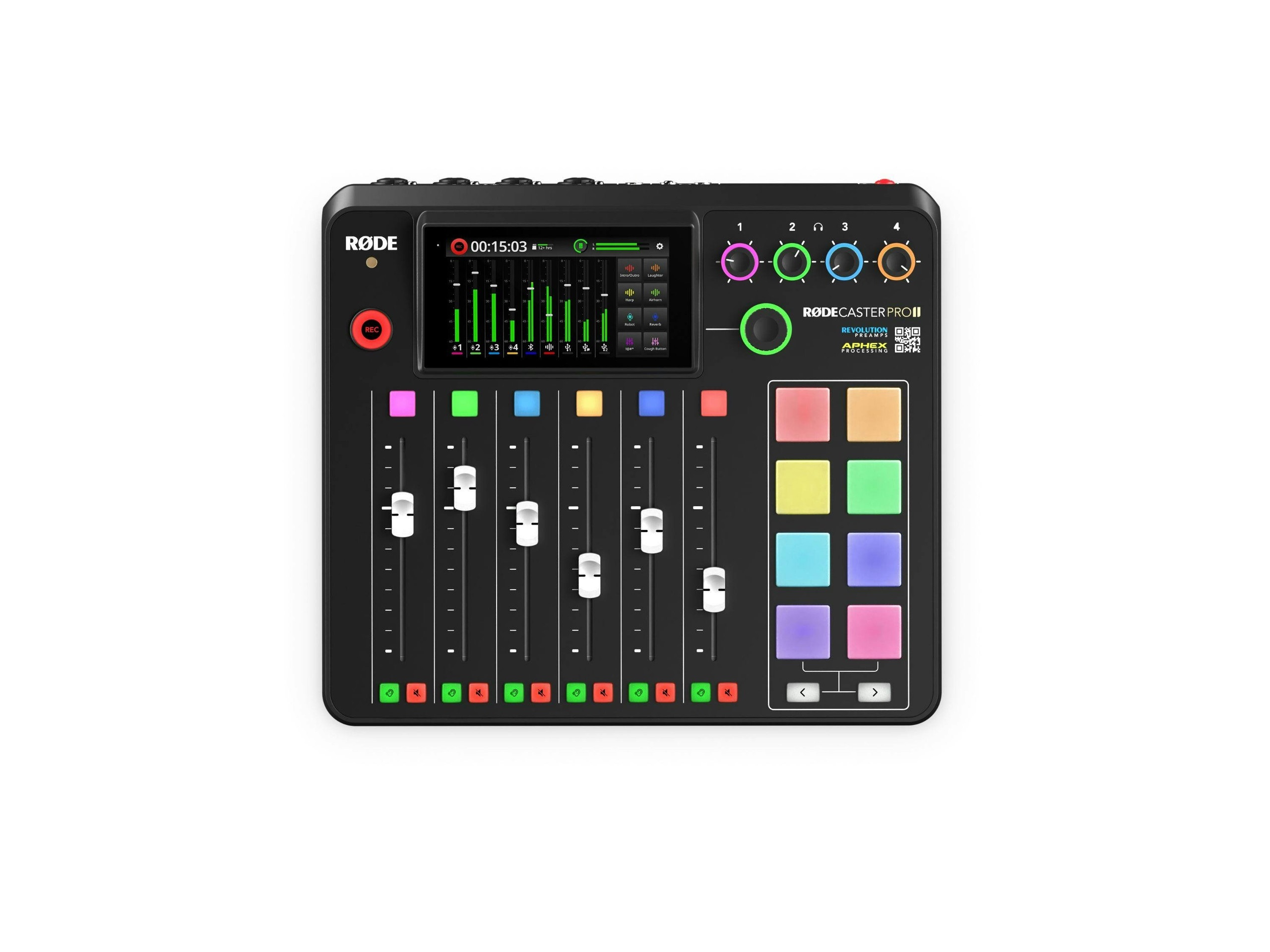
RØDE RØDECaster Pro II Audio Production Console — Black
Four XLR/TRS combo inputs with up to 76 dB preamp gain
The RØDECaster Pro II is a desktop audio production console for podcasting, streaming and music recording. Four XLR/TRS combination inputs accept microphones, instruments or line-level sources, with Revolution preamps offering up to 76 dB of gain. Its mixer has nine assignable channels controlled by six physical faders and three virtual faders; this is not nine physical microphone inputs. Eight programmable SMART pads with bank switching can trigger sounds, effects and mixer actions. Built-in APHEX processing and onboard effects provide tools for shaping individual sources and the main mix. Stereo or multitrack recordings can be made to a microSD card, compatible USB storage or a computer. Two USB-C audio connections allow compatible computers or mobile devices to be connected, while Bluetooth provides another audio source. Four headphone outputs and balanced quarter-inch line outputs support monitoring. A 5.5-inch touchscreen and rotary encoder handle setup and adjustments. The console uses an external power supply, which is included; microphones, headphones, storage media and monitor speakers are not included in this standalone listing.
TASCAM
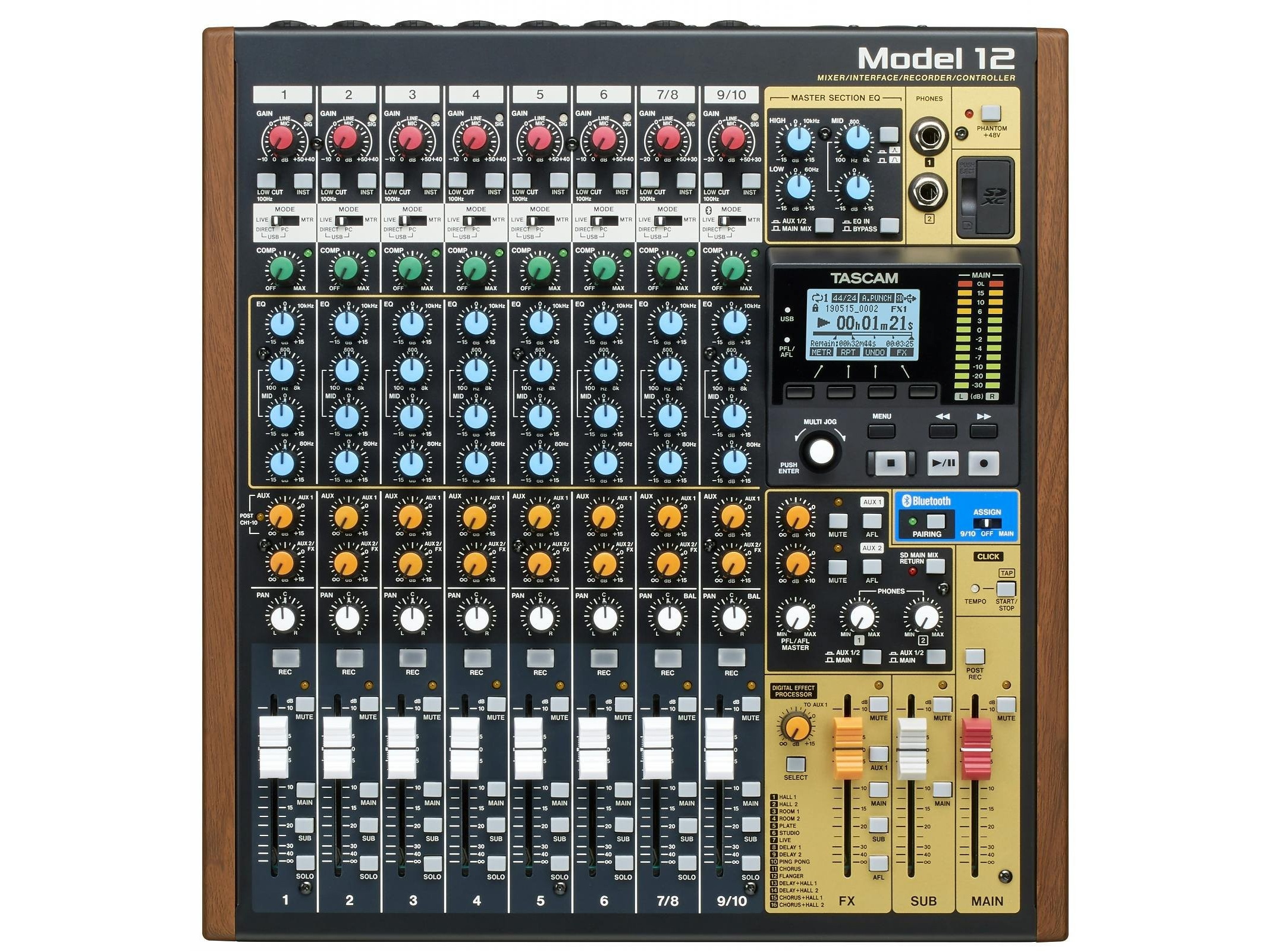
TASCAM Model 12 Mixer, Recorder & USB Audio Interface
Ten analogue inputs: six mono and two stereo channels
The TASCAM Model 12 combines an analogue-style mixing surface with standalone multitrack recording, a USB audio interface and DAW control. Its ten analogue inputs are arranged across six mono and two stereo channels, with eight XLR microphone inputs and switchable 48 V phantom power. The internal recorder can capture ten input tracks plus the stereo main mix to an SD card, creating up to twelve tracks without a computer. Recording is available as 16-bit or 24-bit WAV at 44.1 or 48 kHz; up to ten tracks can be played back simultaneously. Connected to a compatible computer, it operates as a twelve-input, ten-output USB audio interface and supports HUI/MCU DAW control. One-knob compression, channel equalisation and an onboard effects processor provide sound-shaping options. MIDI input and output, Bluetooth audio, a smartphone connection and dual headphone outputs support different production setups. The included mains adaptor powers the mixer; it is not a battery-operated recorder.
Focusrite
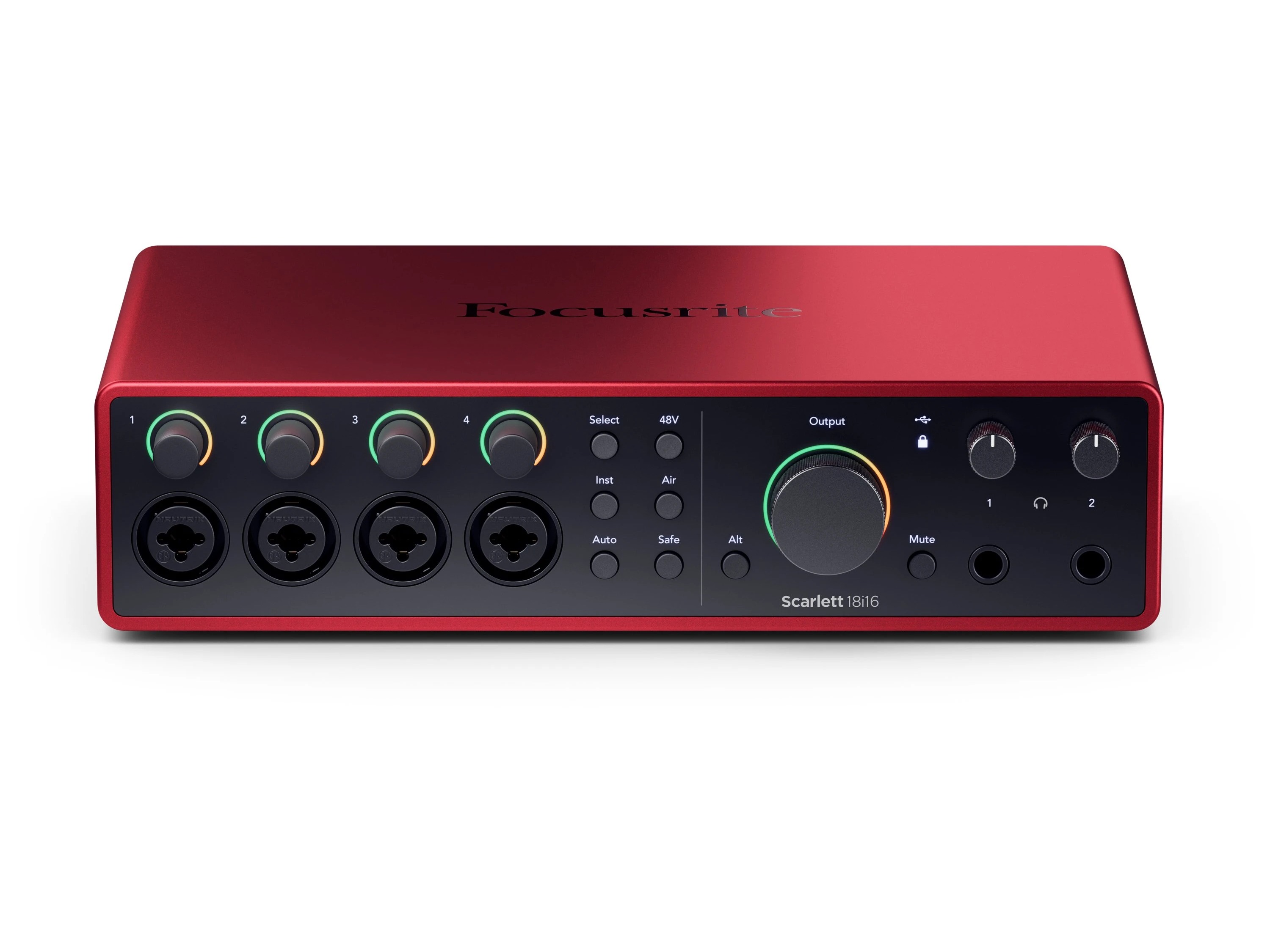
Focusrite Scarlett 18i16 4th Gen USB Audio Interface
Four remote-controllable mic preamps with 69dB gain
The Focusrite Scarlett 18i16 4th Gen is a USB-C audio interface for home and project studios that need more inputs than a desktop two-channel unit. It has four of Focusrite's ultra-low-noise mic/line preamps with a 69dB gain range, which can be adjusted remotely from the Focusrite Control 2 software, while Auto Gain sets recording levels and Clip Safe lowers the gain automatically if a signal is about to clip. Two re-engineered Air modes add the brighter, console-style character Scarlett users know. Inputs 1 and 2 accept guitars and basses directly, and four further line inputs suit synths and drum machines. Optical ADAT adds up to eight extra inputs and outputs and S/PDIF two more, and MIDI in and out sockets let the interface control external MIDI gear. Each set of outputs—monitors, two headphone outputs and line outputs—can carry its own mix, and alternate monitor switching makes it easy to compare two pairs of speakers. Focusrite quotes up to 122dB of dynamic range on the line outputs, with recording at up to 24-bit/192kHz and a Loopback feature for capturing computer audio.
MOTU
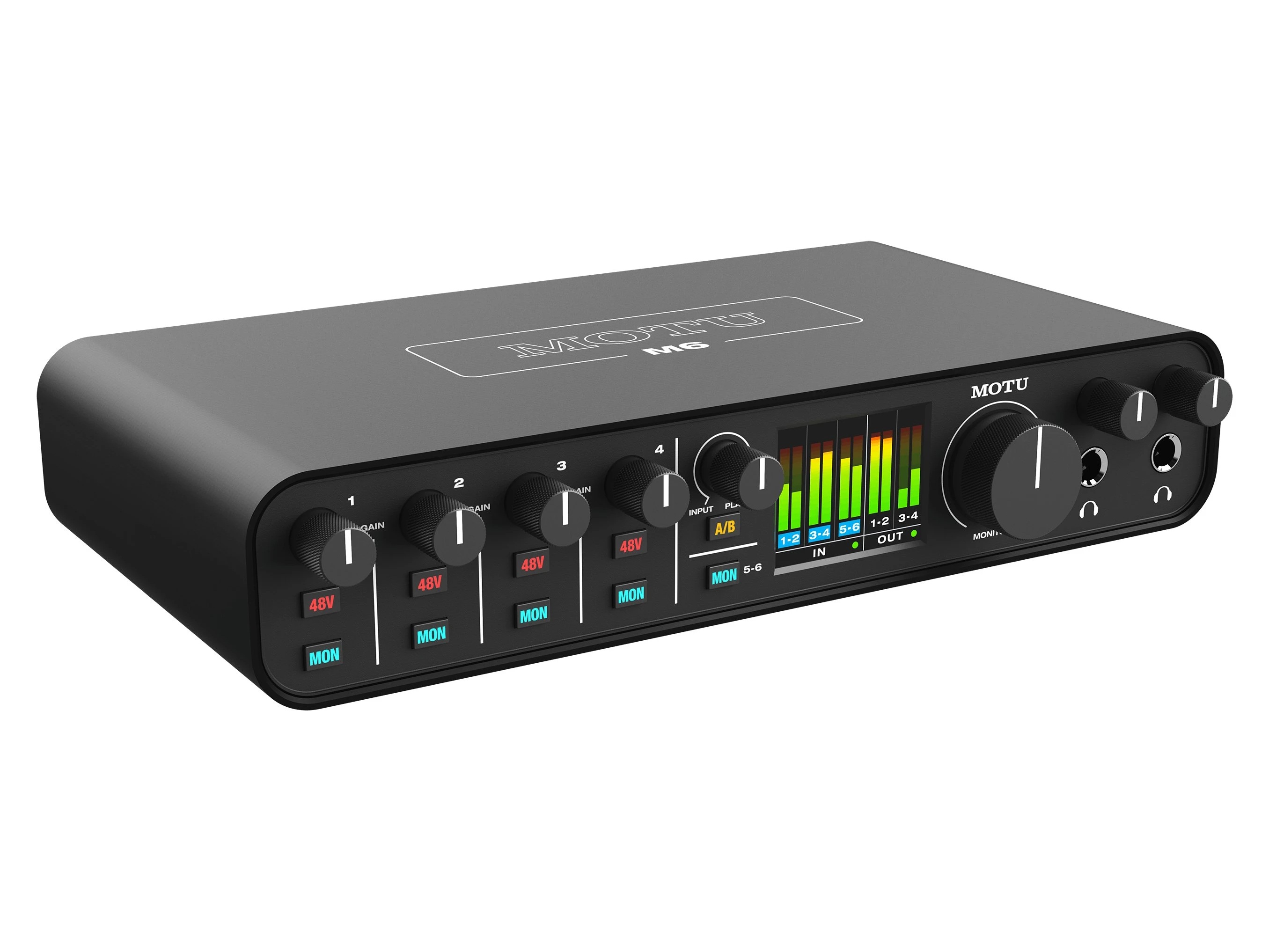
MOTU M6 USB-C Audio Interface
Four mic/line/instrument combo inputs plus two line inputs
The MOTU M6 is a six-input, four-output USB-C audio interface for recording and monitoring with a compatible computer. Four combination XLR/TRS inputs accept microphones, line sources or high-impedance instruments, each with its own preamp control and phantom-power switching. Two additional balanced line inputs complete the six analogue inputs; they are not extra microphone preamps. Four balanced TRS line outputs, two headphone connections with independent volume controls, and MIDI input and output support a range of studio setups. Hardware direct monitoring allows live inputs to be heard without routing them through software first. The monitor-mix control balances those inputs against computer playback, while A/B switching supports comparison between two connected monitor systems. The M6 supports sample rates from 44.1 to 192 kHz. Its driver provides loopback channels for routing computer audio into recording or streaming software. USB-C hosts can supply bus power; other hosts, including USB-A connections, require the included 15 V DC power adapter. Speakers, microphones and instruments are separate purchases.
Tascam
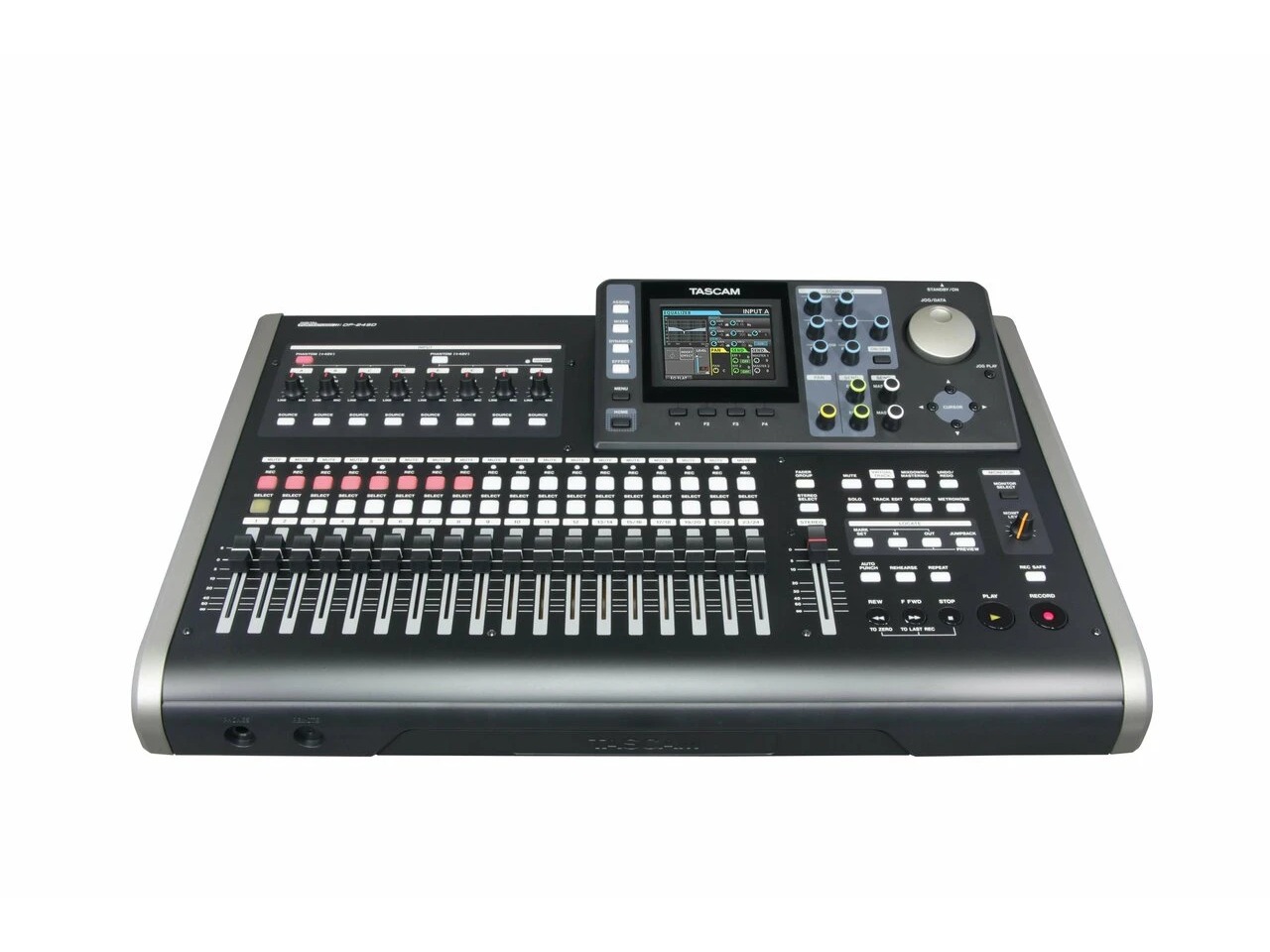
Tascam DP-24SD 24-Track Digital Portastudio
8-track simultaneous recording, 24-track playback
The Tascam DP-24SD is a self-contained 24-track digital Portastudio for recording, mixing and mastering without a computer. Eight XLR/TRS combo inputs with switchable phantom power let you record up to eight sources at once, such as a full drum kit or a band, and input H can be set for a guitar or bass. Playback runs across 24 tracks—twelve mono and six stereo—with 19 track faders and a master fader so every track can be reached without fader layers. Each input and track has its own 3-band semi-parametric EQ, and twelve colour-coded encoders work with the colour LCD for EQ, pan and effect sends. Dynamics for the inputs, guitar multi-effects, mix-down reverb, delay and chorus, and mastering tools including a multi-band compressor, EQ and normaliser are built in, along with track bounce and eight virtual tracks per track for alternate takes. Recordings are made at 44.1kHz or 48kHz in 16-bit or 24-bit to SD/SDHC cards of up to 32GB, and files can be transferred to a computer via USB 2.0. Outputs include stereo RCA, two effect sends and a 70mW-per-channel headphone output. Tascam lists the weight as 6.2kg.
Audient
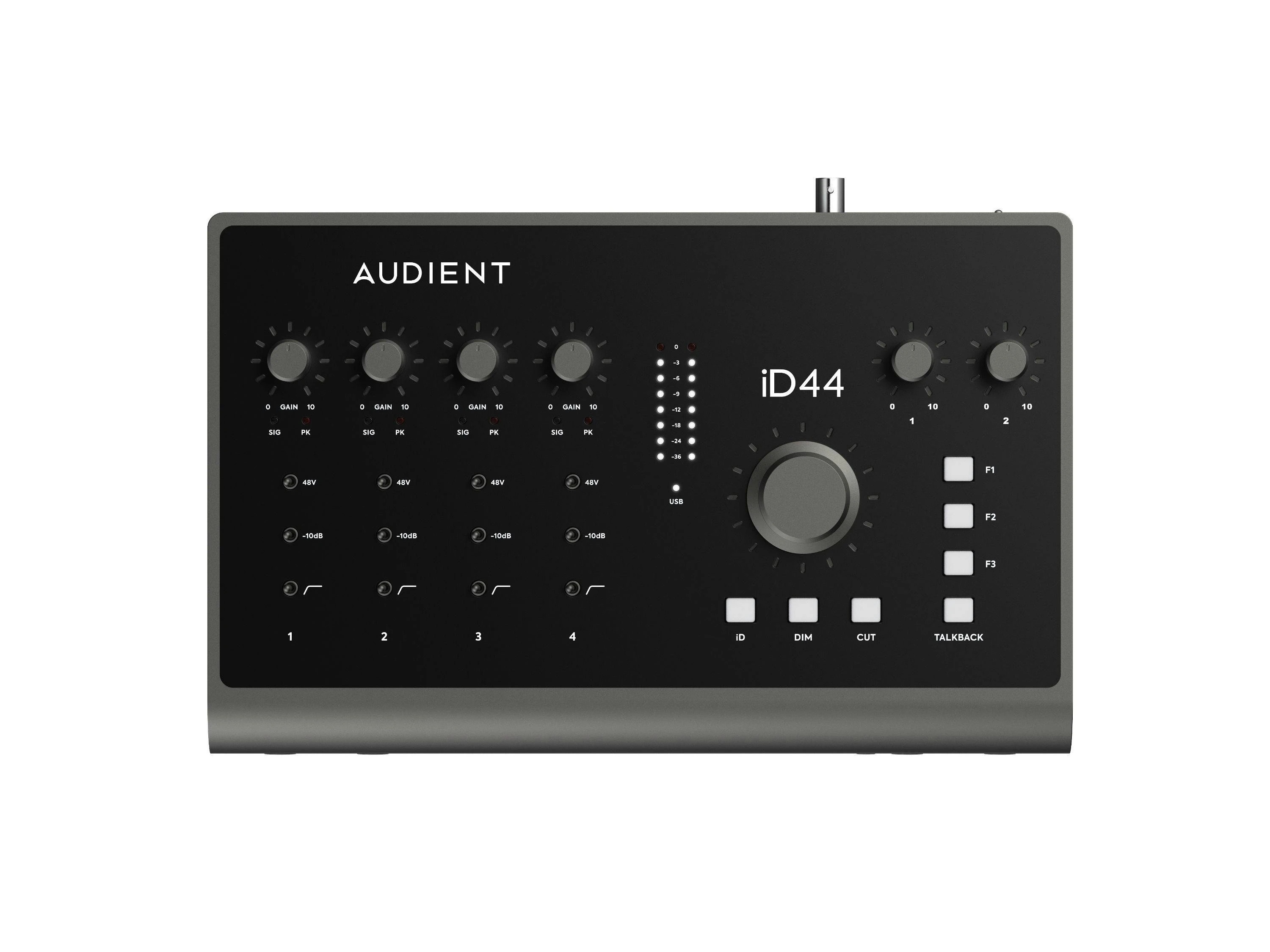
Audient iD44 MKII
Four microphone preamps with up to 60 dB gain
The Audient iD44 MKII is a desktop USB audio interface for recording microphones, instruments and line-level sources. Four microphone preamps provide up to 60 dB of microphone gain, with phantom power available for suitable condenser microphones. Two front-panel instrument connections support guitar and bass recording, while analogue insert connections on the first two input channels allow external processing to be integrated into the recording path. Its quoted 20-input and 24-output capacity combines analogue and digital channels. The manufacturer specifies four analogue inputs and sixteen digital inputs at 44.1 or 48 kHz; the available ADAT channel count falls at higher sample rates. Optical inputs and outputs support ADAT expansion or stereo S/PDIF, rather than adding more built-in microphone sockets. Four line outputs serve monitoring or external equipment, and dedicated headphone outputs provide personal monitoring. The USB Type-C socket operates using USB 2.0 High Speed, so the connector should not be confused with a USB 3 protocol specification. This is the MKII model: newer-generation iD44 converter claims are not assumed to apply to it.
Audient
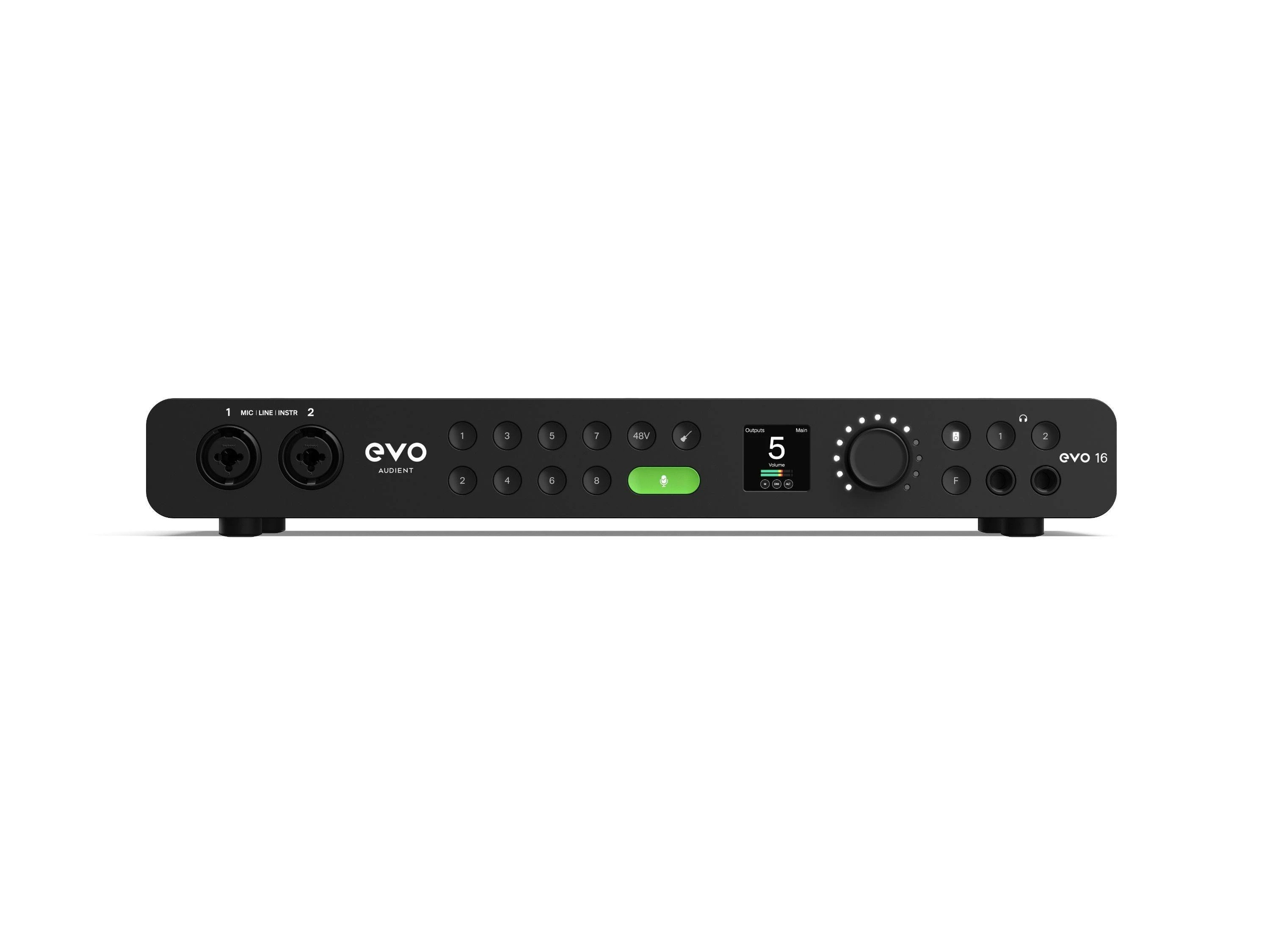
Audient EVO 16
Eight microphone preamps with 58 dB gain
The Audient EVO 16 is a desktop audio interface with eight microphone preamps for recording several sources in one session. Smartgain can analyse incoming signals and set input gain automatically, helping with initial level setting when recording alone or preparing a larger session. Each preamp offers a 58 dB gain range, while phantom power supports microphones that require it. Two instrument inputs provide a connection for guitar or bass, and eight line outputs allow audio to be routed to monitors or external equipment. Two dedicated headphone amplifiers provide personal monitoring. The colour display and Motion UI controls bring channel settings and metering together on the unit, while the software mixer supports monitoring and routing from a compatible computer. Optical digital inputs and outputs support ADAT or S/PDIF expansion. The advertised 24-input and 28-output capacity therefore includes digital channels and should not be read as twenty-four built-in microphone sockets. The physical preamp count remains eight. This interface is for computer-based recording, not a standalone recorder, and additional converters or preamps are required to use the expanded digital channel capacity.
Reloop
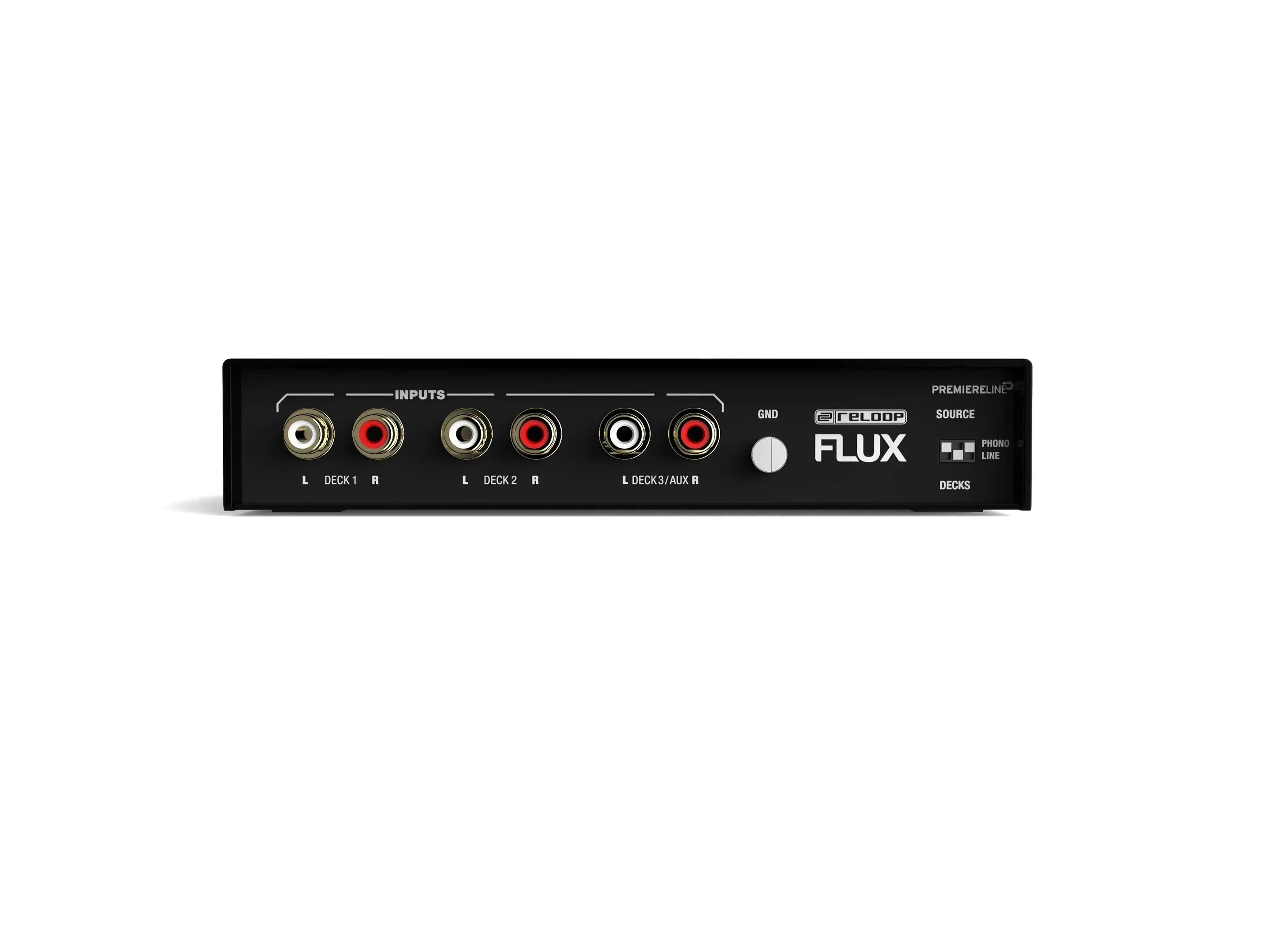
Reloop FLUX USB-C DVS Audio Interface
USB-C DVS audio interface
The Reloop FLUX is a USB-C audio interface designed for compatible Serato DJ Pro digital vinyl setups. It provides three stereo inputs and three stereo outputs, an auxiliary output and a built-in two-port USB-A hub. The manufacturer specifies audio operation up to 24-bit/96 kHz. These connections link a suitable computer, mixer and playback sources; the FLUX is not itself a standalone DJ mixer, media player or loudspeaker system. Software entitlements and compatible DVS requirements should be checked for the chosen workflow rather than copied from a different Reloop mixer bundle. This listing supplies one interface and does not include the turntables, mixer, laptop or cables shown in illustrative system pictures. Those promotional and connection scenes have been excluded from the clean exact-product gallery.
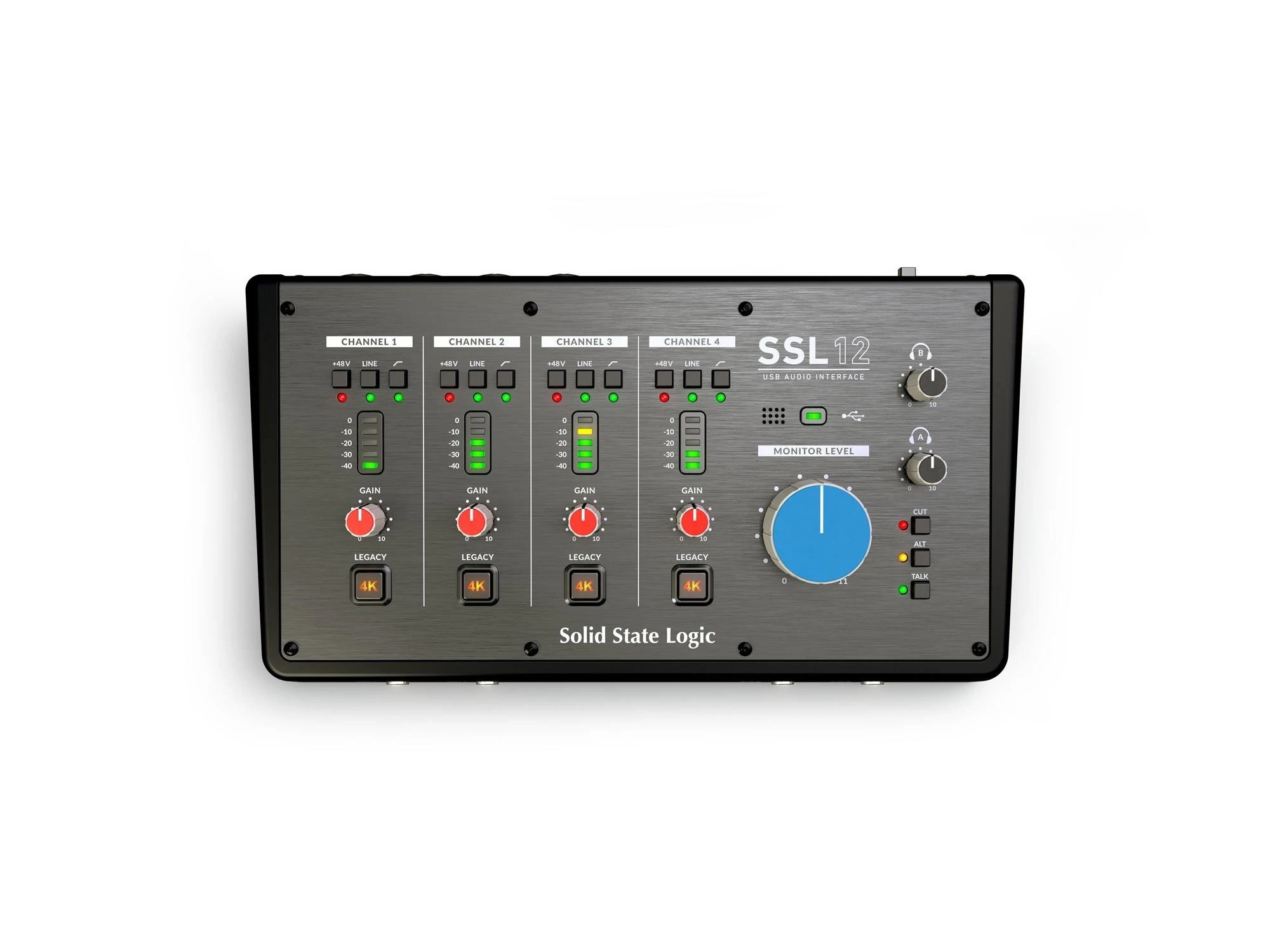
Solid State Logic
SSL 12 USB Audio Interface
Four analogue microphone preamps
The Solid State Logic SSL 12 is a desktop USB recording interface with four analogue microphone preamps. Each channel has gain control, phantom power and a selectable Legacy mode, while the front-panel instrument connections provide an alternative for compatible guitars and other high-impedance sources. Its advertised twelve-input configuration includes digital expansion: the optical ADAT input can add up to eight channels from suitable external equipment, rather than providing twelve physical analogue sockets. The top-panel monitor control and headphone connections support recording and playback workflows. SSL 360 software provides a configurable mixer for monitoring and loopback, allowing computer playback to be routed into a recording or streaming application. Available ADAT channel counts depend on the selected sample rate and connected equipment. SSL describes the interface as USB bus-powered, using USB 3.0 for power while audio communication follows the USB 2.0 protocol. This is an audio interface for use with a compatible computer, not a self-contained recorder. Microphones, external ADAT preamps, speakers and a computer are not included in this listing.