Two Tone / 34 products
Studio & recording
Audio interfaces, studio monitors and microphones for recording and mixing.
In stock · Free UK delivery. Online ordering opens soon.
1–24 of 34 products
Solid State Logic
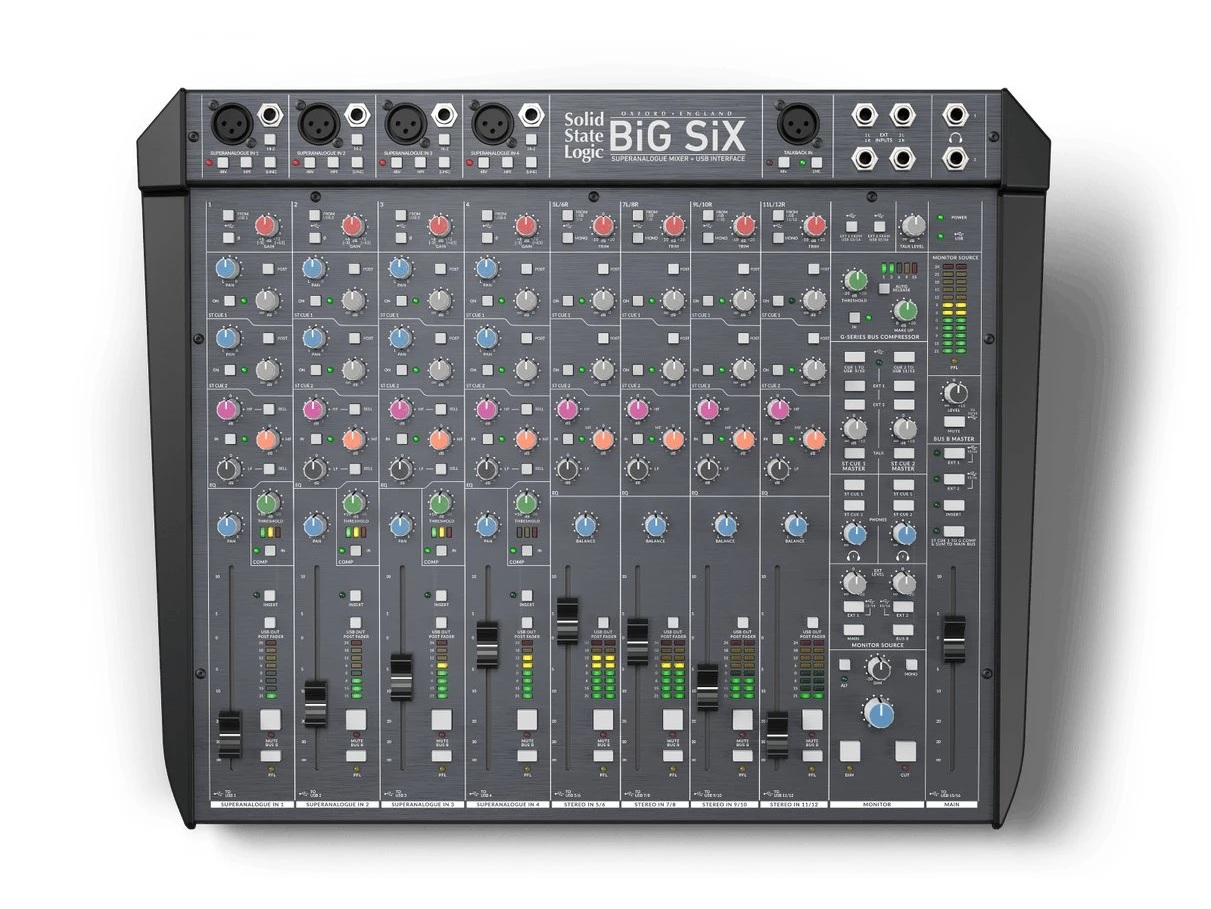
Solid State Logic BiG SiX Desktop Mixer
Four SuperAnalogue mic preamps
The Solid State Logic BiG SiX is an analogue desktop mixer with an integrated USB audio interface for recording, summing and monitoring. Four mono channels provide SuperAnalogue microphone preamps, while four stereo input channels handle additional line-level sources. The stereo channels are not four extra microphone preamps, and the mixer must not be confused with the smaller SSL SiX. BiG SiX incorporates three-band E-Series channel EQ, channel compression on the mono input paths and a G-Series bus compressor on the main mix. SSL describes sixteen channels of USB conversion for computer integration. These routing and conversion capabilities do not mean sixteen physical microphone inputs. Its two independent headphone outputs and monitor routing support different listening feeds without making the connected headphones or speakers part of this listing. The controls and analogue connections make it suitable for combining microphones, instruments and playback sources with a compatible recording system. A computer and appropriate software are needed for computer-based recording; microphones, headphones and speakers are separate requirements. The product photographs show the mixer from several angles, while the separate mounting-hardware image has been removed from the gallery. This listing is BiG SiX, not a software-only mixer or a standalone multitrack recorder.
Universal Audio
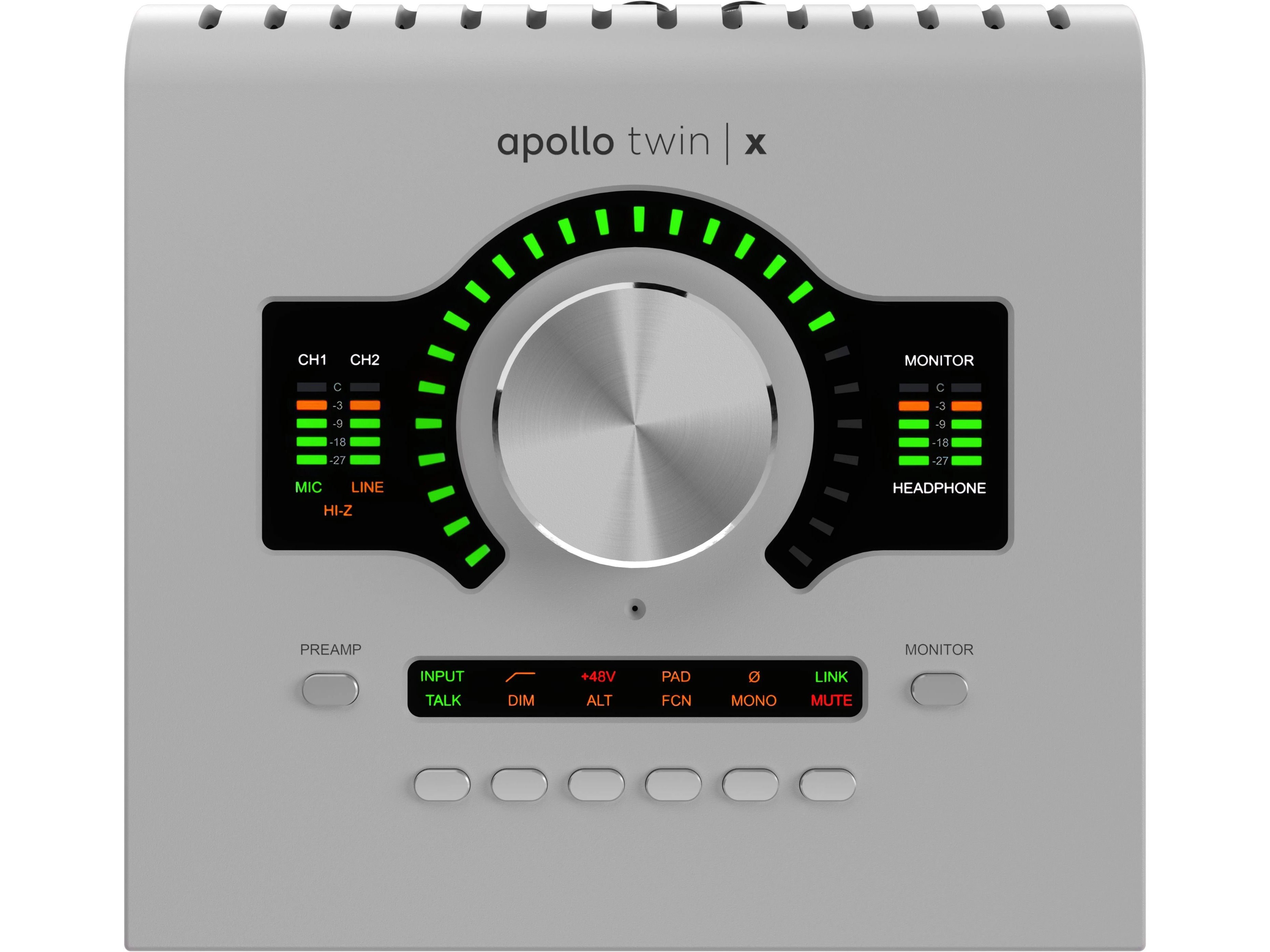
Universal Audio Apollo Twin X DUO Gen 2 Thunderbolt Audio Interface, UAD Analog Classics
10-in/6-out Thunderbolt interface
The Universal Audio Apollo Twin X DUO Gen 2 is a 10-in/6-out Thunderbolt desktop audio interface with built-in DUO Core DSP, supplied here with the UAD Analog Classics plug-in bundle. Its two Unison mic preamps take on the tone and response of classic analogue preamps from makers such as Neve, API and Manley when used with Unison plug-ins, and the onboard DSP lets you record through UAD plug-ins in real time. A front-panel Hi-Z input accepts guitar or bass, and an optical Toslink input adds ADAT or S/PDIF channels. On the rear are two 1/4" monitor outputs and two 1/4" line outputs that can be used as an alternate speaker pair, with a 1/4" TRS headphone output on the front. Apollo X Gen 2 conversion runs at up to 24-bit/192kHz, and Universal Audio quotes 129dB of dynamic range on the D/A. The updated UAD Console app adds Auto-Gain, Plug-In Scenes, bass management for a subwoofer and immersive audio support, and Apollo Monitor Correction by Sonarworks can calibrate the monitor and headphone outputs. A Thunderbolt-equipped computer is required.
AKG
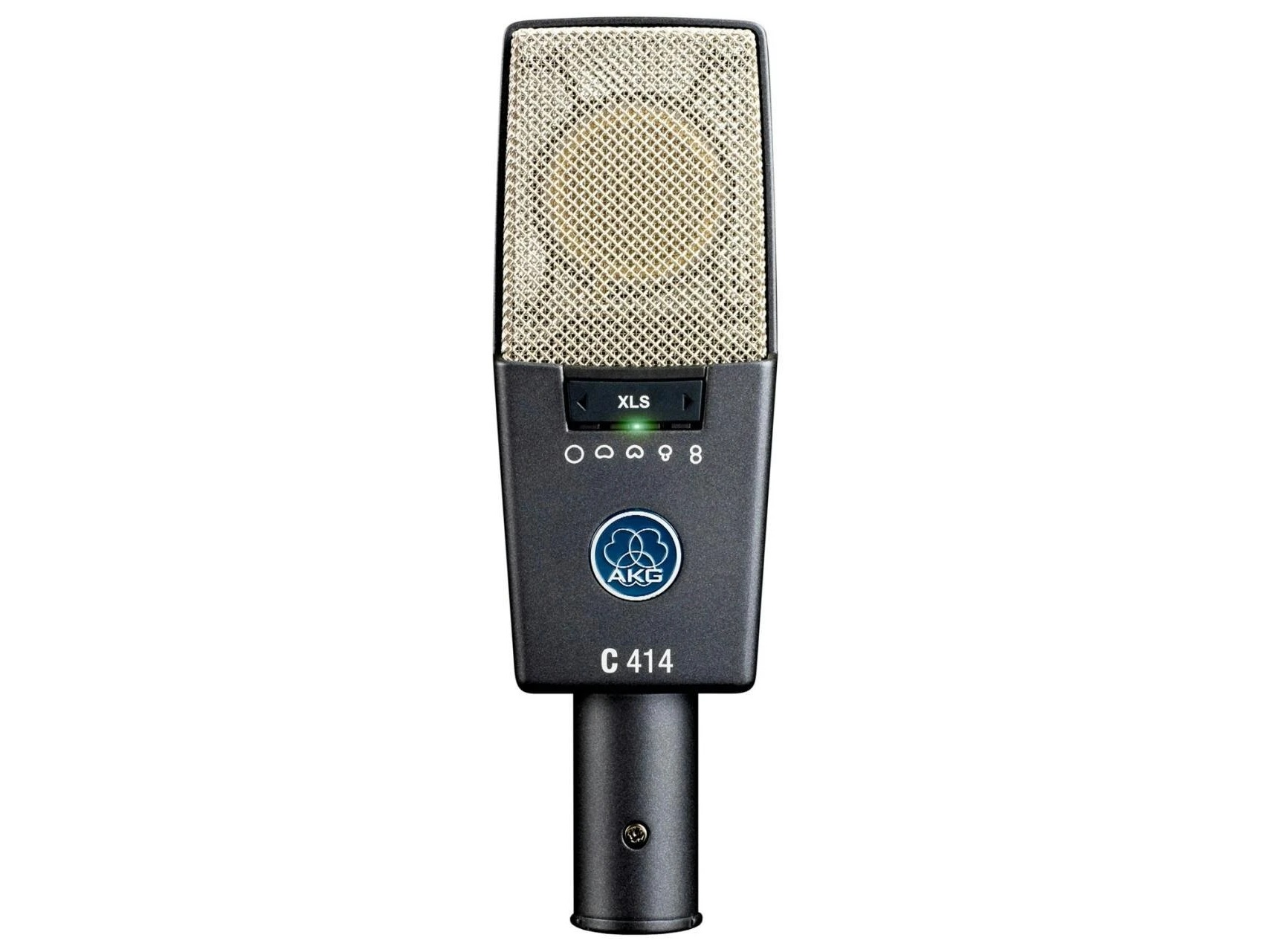
AKG C414 XLS Multi-Pattern Condenser Microphone — Single
Nine selectable pickup patterns
The AKG C414 XLS is a large-diaphragm condenser microphone with nine selectable pickup patterns, allowing the same microphone to suit different vocal and instrument recording arrangements. Its controls include omnidirectional, cardioid and figure-eight positions with intermediate options. This is the XLS version with its reference-oriented voicing, not the presence-enhanced XLII model. It is supplied as one microphone rather than a matched stereo pair. Switchable attenuation provides 6, 12 or 18 dB of level reduction for loud sources. Three bass-cut options operate at 40, 80 and 160 Hz, letting the user reduce low-frequency content at the microphone. The manufacturer specifies 20 Hz to 20 kHz frequency range and 48 V phantom powering through the three-pin XLR connection. A peak-hold indicator helps identify signal overload, while a control-lock function can prevent accidental setting changes. The standard package includes a shock mount, windscreen, pop filter and carrying case. Those accessories do not turn it into a complete recording system: a compatible phantom-powered microphone input, suitable support and recording equipment are still required. Pattern selection and placement influence how much room sound is captured; none of the settings guarantees background-noise elimination.
Solid State Logic
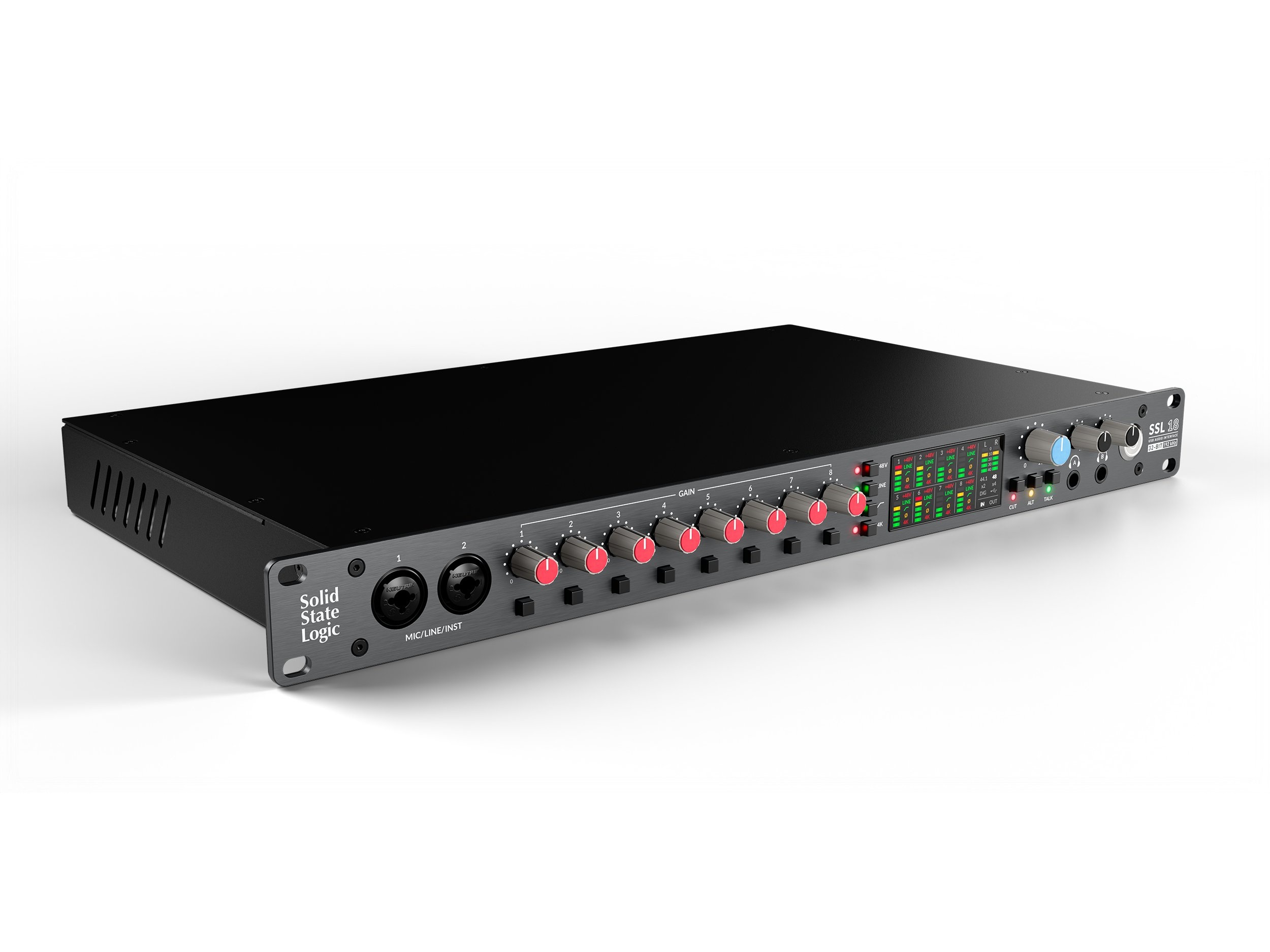
SSL 18 USB Audio Interface
Eight SSL-designed analogue preamps
The Solid State Logic SSL 18 is a rackmount USB audio interface designed for recording and monitoring with a compatible computer. Eight SSL-designed analogue preamps provide the core recording inputs, with selectable Legacy 4K analogue enhancement. Its advertised 26-input, 28-output configuration also includes digital connections and should not be described as twenty-six analogue microphone inputs. The digital section provides up to sixteen channels of ADAT input and output, plus stereo S/PDIF input and output. Available ADAT channel counts depend on the sample rate and connected equipment. Ten balanced analogue outputs support studio routing, and the configurable monitor control can be assigned to appropriate outputs through SSL 360 software. SSL specifies next-generation 32-bit/192 kHz converters. Headphone monitoring, MIDI connections and stereo loopback add recording and production options. A dedicated talkback path features SSL’s Listen Mic Compressor; this does not mean that every microphone input has that compressor. External digital preamps, microphones, speakers and a computer are separate purchases. This interface is not a standalone multitrack recorder.
Focal Professional
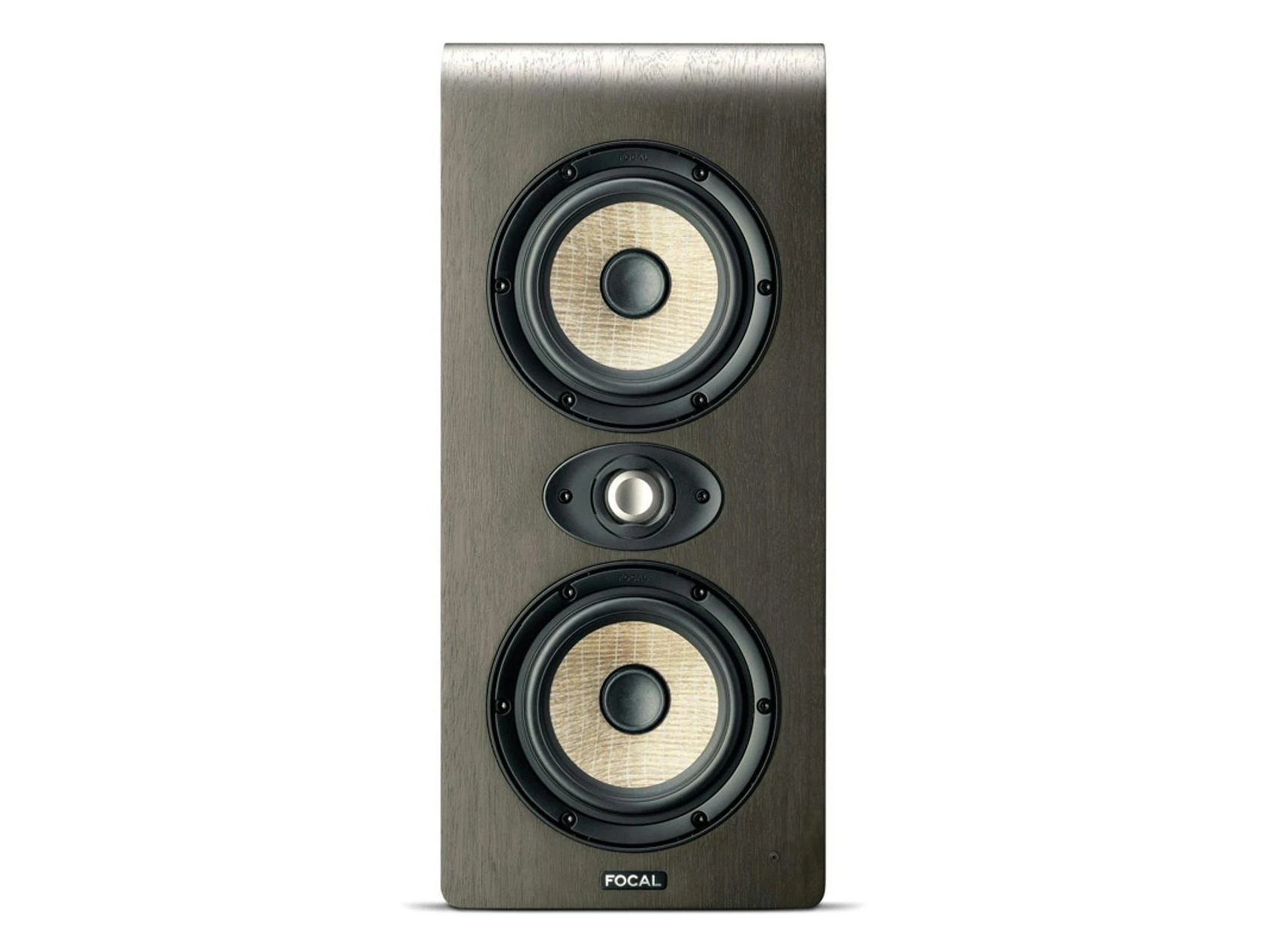
Focal Shape Twin — single monitor
Single powered 2.5-way studio monitor
The Focal Shape Twin is a powered studio monitor supplied here as one loudspeaker, not a pair. Its 2.5-way design uses two five-inch Flax-cone woofers with a one-inch aluminium-magnesium M-profile tweeter. Two side-mounted passive radiators support the bass loading; they are not additional powered woofers. Three Class AB amplifier stages drive the active loudspeaker sections. Focal’s specification table gives a frequency response of 40 Hz to 35 kHz within ±3 dB and a maximum sound pressure level of 110 dB peak at one metre. The peak figure is not a continuous-output rating. Balanced XLR and unbalanced RCA inputs allow connection to suitable recording interfaces or monitoring controllers. Acoustic adjustments help tailor the response to the installation, while the passive-radiator arrangement avoids a conventional bass-reflex port. The cabinet measures 478 mm high, 211 mm wide and 279 mm deep and weighs 11 kg. This model should not be described as a three-way monitor merely because it has three active drivers. A stereo monitoring setup needs a second unit purchased separately.
Neumann
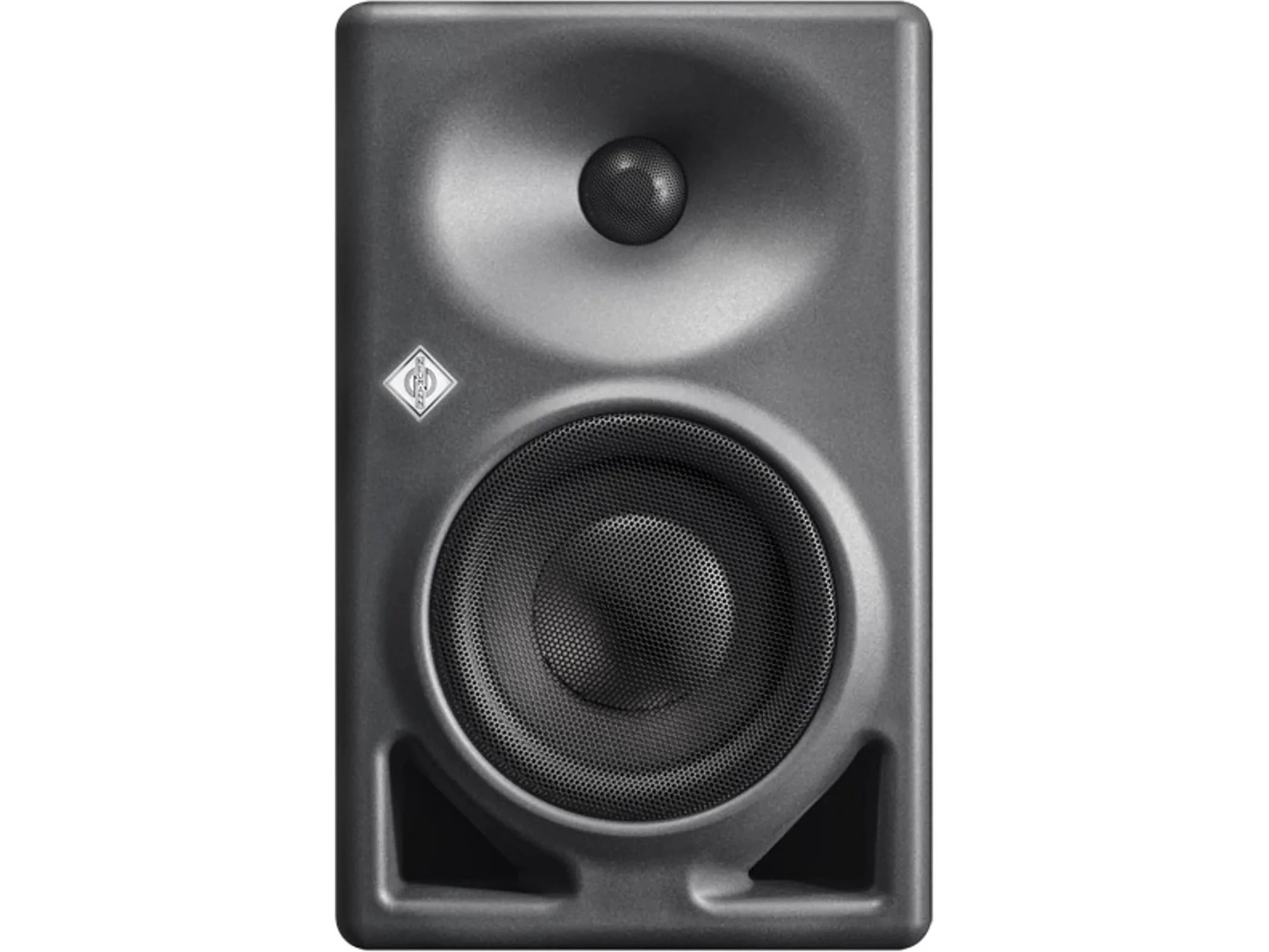
Neumann KH 120 II Anthracite — single monitor
Single anthracite powered two-way monitor
The Neumann KH 120 II is a powered two-way studio monitor supplied here as one anthracite loudspeaker. Its five-and-a-quarter-inch woofer and one-inch tweeter work with built-in DSP-controlled electronics. This is the second-generation KH 120 II, rather than the earlier KH 120 model, and the price is for one unit rather than a stereo pair. The standard model provides analogue and S/PDIF digital connectivity. Its network connection supports control and alignment, and should not be advertised as an AES67 audio connection: Neumann offers a separate AES67 version. Local controls and network-based adjustment provide options for installation in recording and production spaces. Neumann publishes a free-field response of 44 Hz to 21 kHz within ±3 dB. That qualified frequency range is distinct from manufacturing-tolerance specifications and must not be rewritten as an unspecified perfectly flat response. The monitor can work with Neumann’s MA 1 alignment system, but this listing does not include that additional system. Built-in amplification means a separate speaker power amplifier is unnecessary; a stereo setup requires two monitors.
Audient
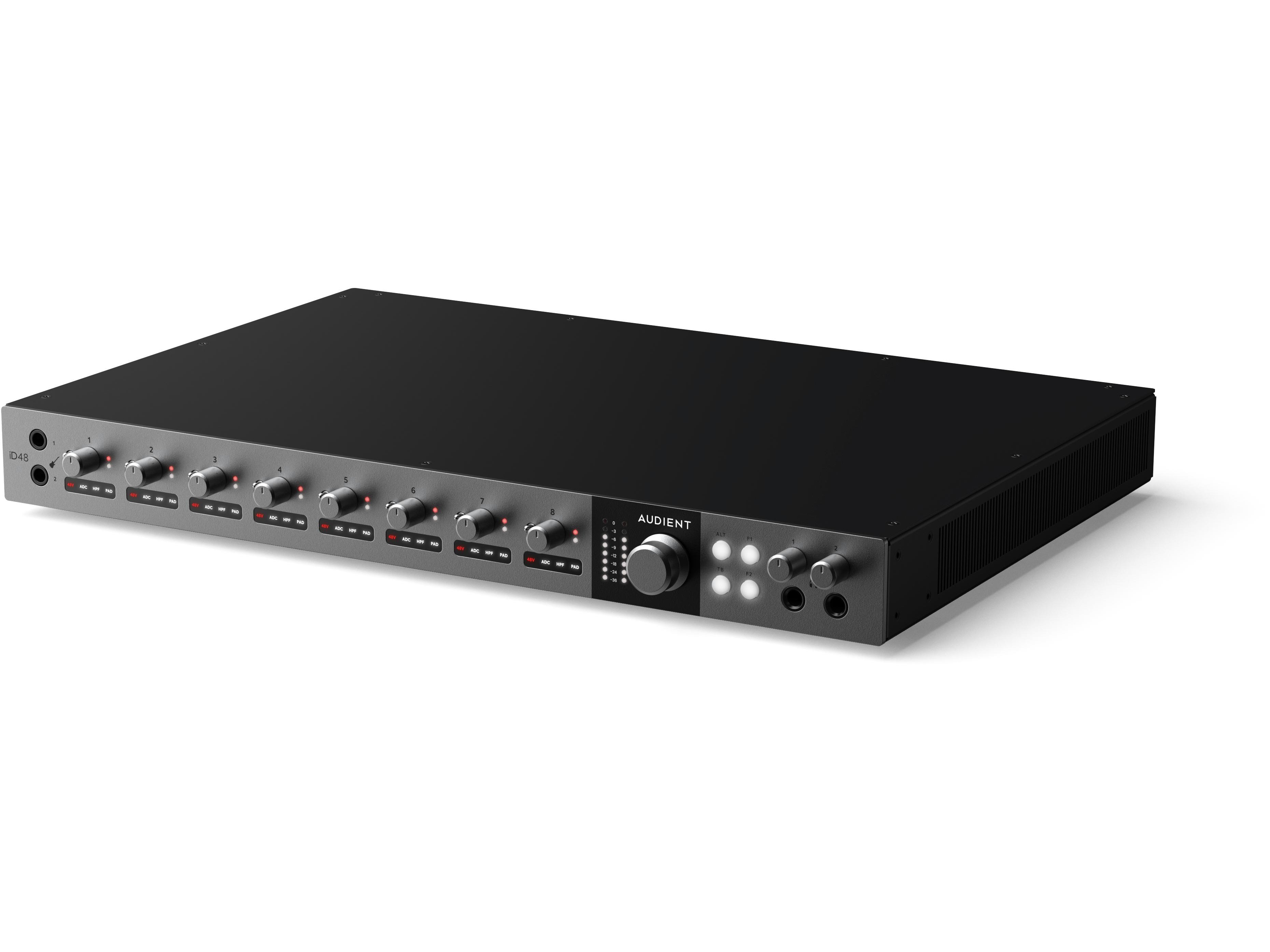
Audient iD48 24-in/32-out USB Audio Interface with 8 Console Mic Preamps
Eight Audient console mic preamps, up to 68dB gain
The Audient iD48 is the flagship of Audient's iD interface range, a rack-format USB audio interface that Audient describes as 24-in and 32-out. It suits project studios that record full bands, use outboard gear or need plenty of monitoring outputs. Eight Audient console microphone preamps sit on XLR and jack combo sockets, each offering up to sixty-eight decibels of gain including a ten-decibel gain boost, switchable forty-eight-volt phantom power, a ten-decibel pad and a hundred-hertz high-pass filter. Audient quotes an equivalent input noise of minus one hundred and twenty-seven dBu. Channels one and two also have front-panel instrument inputs for guitar or bass. The converters are specified at one hundred and twenty decibels A-weighted dynamic range on the inputs and up to one hundred and twenty-six and a half decibels A-weighted on the outputs, with operation up to ninety-six kilohertz. Digital expansion and multiple line and headphone outputs allow the channel count to grow with additional preamps. The 1U metal chassis arrives configured for desktop use, and rack ears are included for mounting in a nineteen-inch rack. Andertons lists the unit as 28 outputs; this listing follows Audient's own 32-output figure.
RME
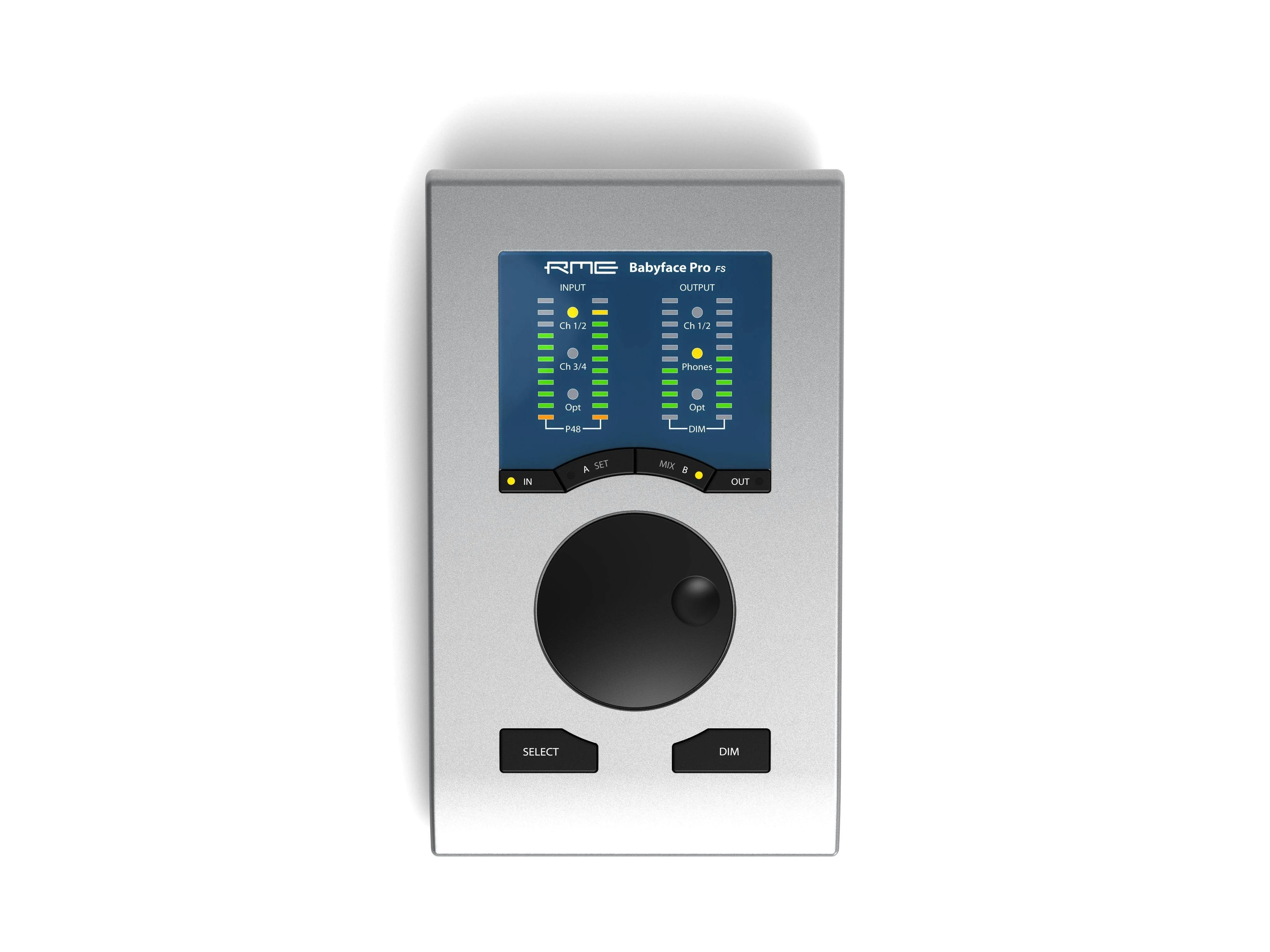
RME Babyface Pro FS
Two XLR mic/line and two line/instrument inputs
The RME Babyface Pro FS is a compact USB audio interface with an aluminium housing and physical controls for recording and monitoring. Two balanced XLR mic/line inputs are joined by two unbalanced line/instrument inputs, allowing microphones and instruments to be connected without treating the headline channel count as a count of microphone sockets. Balanced XLR main outputs feed monitoring equipment, while headphone connections provide personal listening. The computer connection uses USB 2.0, and supported operation extends up to 192 kHz. Its optical input and output can carry ADAT with SMUX support or S/PDIF, depending on the session configuration. RME’s twenty-four-channel headline combines input and output capacity and includes digital channels; the unit does not have twenty-four analogue inputs. TotalMix FX supports audio routing and monitor mixing, with onboard effects available in the monitoring workflow. The FS model includes SteadyClock FS and an output-level switch for the balanced main outputs. USB bus power supports portable use with suitable computer ports, while actual channel availability depends on sample rate and the connected digital equipment.
MOTU
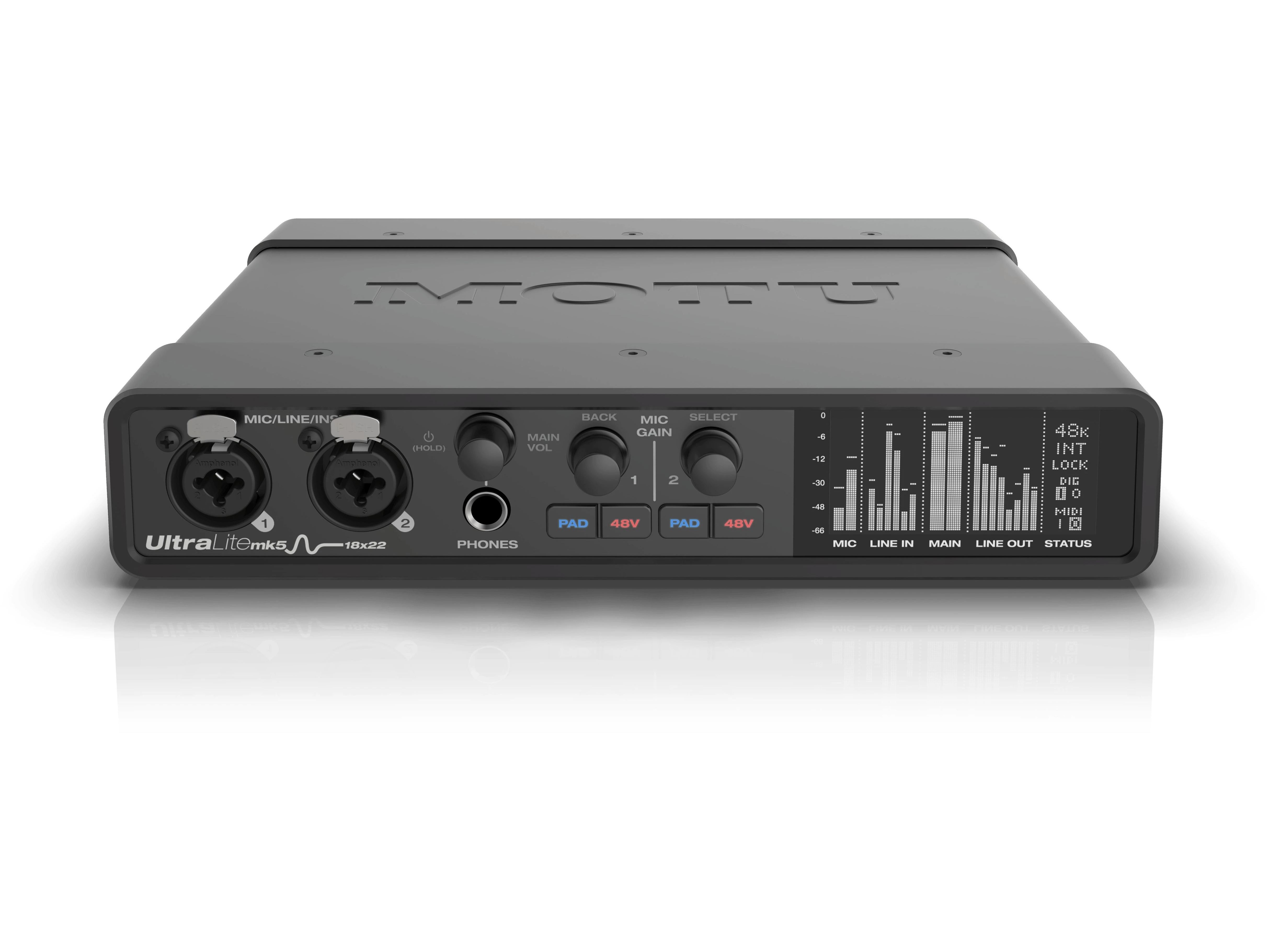
MOTU UltraLite-mk5 USB Audio Interface
Two mic/line/instrument combo inputs
The MOTU UltraLite-mk5 is a compact USB audio interface with analogue and digital connections for recording, playback and monitor mixing. It provides two microphone, line or instrument combo inputs plus six balanced quarter-inch TRS line inputs. The advertised 18-input and 22-output totals include digital channels at standard sample rates; they do not mean eighteen microphone preamps or eighteen analogue inputs. MOTU specifies ten balanced TRS analogue outputs, a headphone output, optical digital I/O and S/PDIF connections. Available channel counts reduce at higher sample rates, so the full 18-in/22-out configuration should not be assumed at every recording setting. MIDI input and output connect compatible external MIDI equipment. The built-in DSP mixer provides EQ, compression and reverb for monitor mixes. Computer recording and playback still require a compatible system and software; the mixer is not a promise that every plug-in can run inside the interface. The unit uses its external power supply rather than relying on USB bus power. This is the mk5 model, not an earlier UltraLite generation. Microphones, instruments, loudspeakers and their signal cables are separate requirements, and the photographs show the interface itself rather than a complete studio.
ADAM Audio
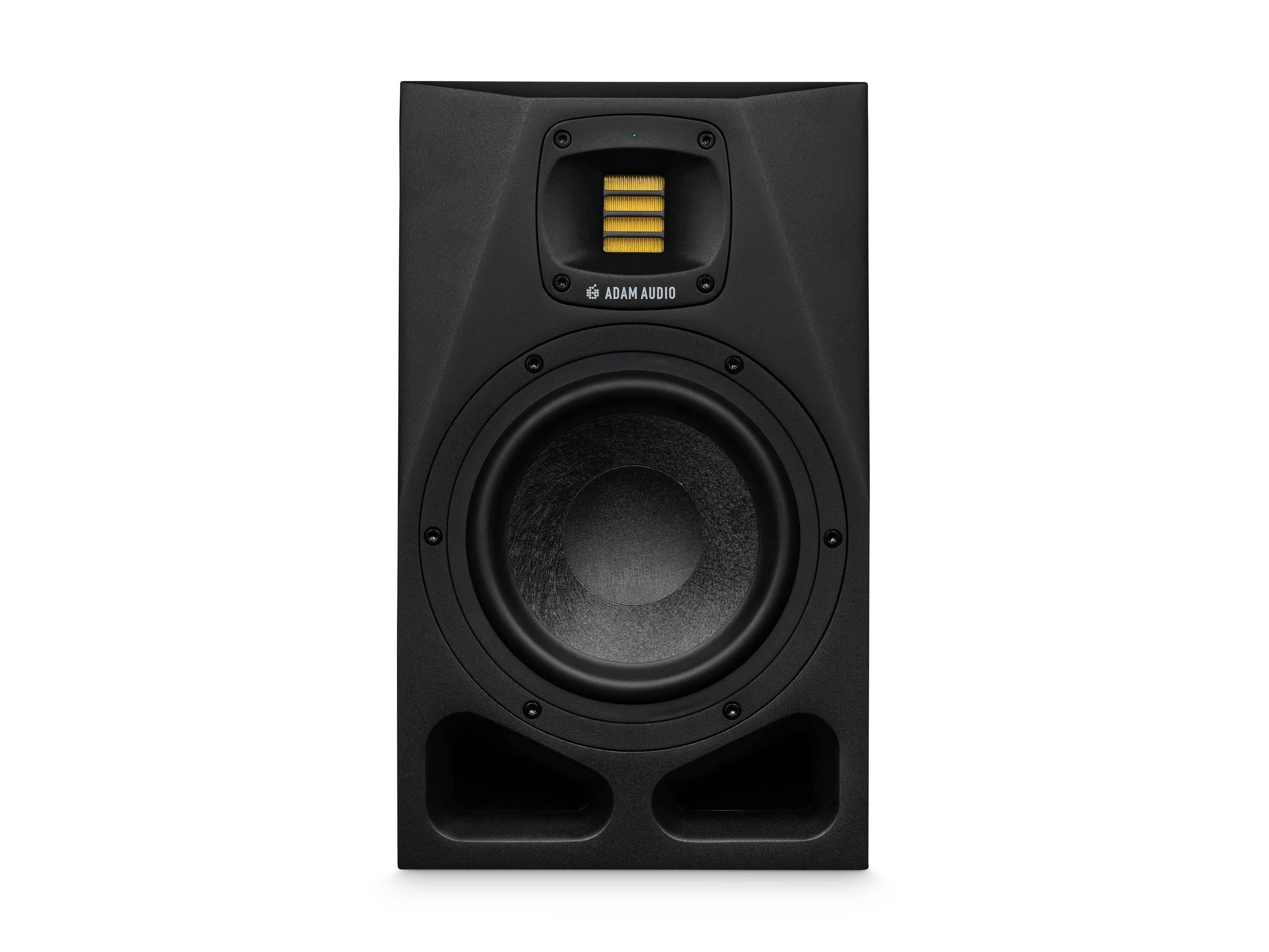
ADAM Audio A7V Black — single monitor
Single black powered two-way monitor
The ADAM Audio A7V is a powered two-way studio monitor supplied here as one black loudspeaker. It combines a seven-inch Multi-Layer Mineral-fibre woofer with ADAM’s X-ART tweeter. The front-facing ports, rotatable HPS waveguide and onboard DSP form part of the monitor’s acoustic design, with tuning options intended to help adapt its response to the listening environment. Balanced XLR and unbalanced RCA sockets provide analogue audio inputs. The separate Ethernet-style socket is labelled Remote Control on the product itself; it must not be presented as a network-audio input. Rear-panel controls provide room adaptation, voicing and level adjustment without requiring a separate speaker power amplifier. The manufacturer lists a frequency range of 41 Hz to 42 kHz on its product overview. That range is not presented here as a tolerance-qualified flat response, and no unsupported continuous amplifier rating is assigned. This is the A7V generation rather than the older A7X. The price covers one monitor, so a conventional stereo monitoring setup requires two units.
Dynaudio
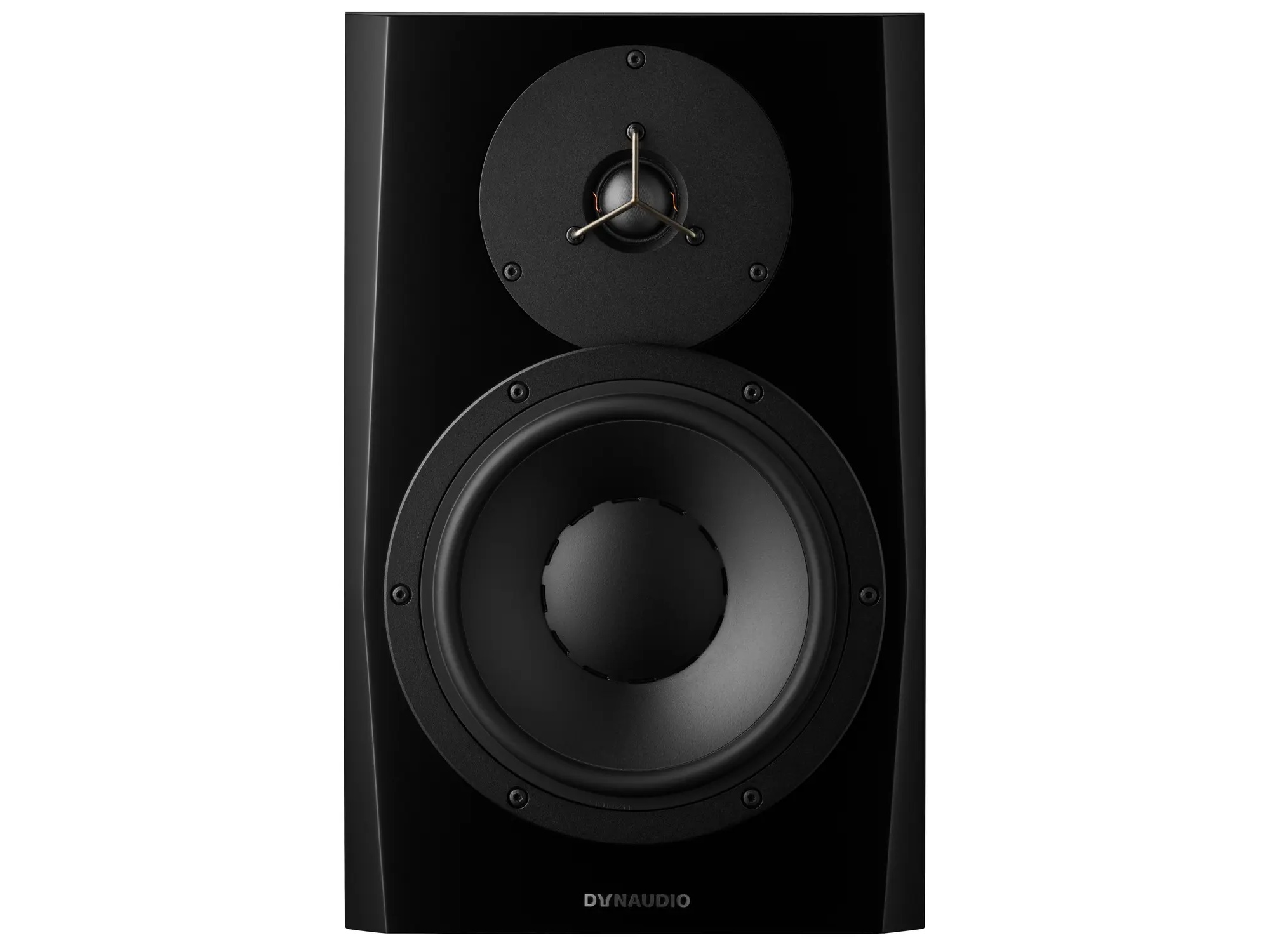
Dynaudio LYD 8 8-inch Active Studio Monitor — Black Single
Single black monitor with 8-inch woofer and 1-inch soft-dome tweeter
The Dynaudio LYD 8 is a black active nearfield studio monitor offered as one speaker, not a stereo pair. Its 8-inch woofer and one-inch soft-dome tweeter are driven by separate Class D amplifiers: 80 watts for the low-frequency section and 50 watts for the high-frequency section. Balanced XLR and unbalanced RCA inputs provide analogue connections for a suitable audio interface, mixer or playback source. Rear-panel DSP controls adjust Bass Extension and Sound Balance, while the Position setting offers separate tuning for free-standing placement or placement within 50 centimetres of a wall. The wall setting is an acoustic tuning option, not a promise of included wall-mounting hardware. These settings allow the monitor to be adapted to its listening environment without an external control application. Dynaudio lists dimensions of 234 × 369 × 328 mm and a weight of 10.2 kg for this model. A second matching monitor is needed for stereo monitoring. Manufacturer maximum sound-pressure figures measured with a pair are not presented as single-speaker ratings, and no unsupported software, mounting accessories or untoleranced full frequency-response claim is included.
Neumann
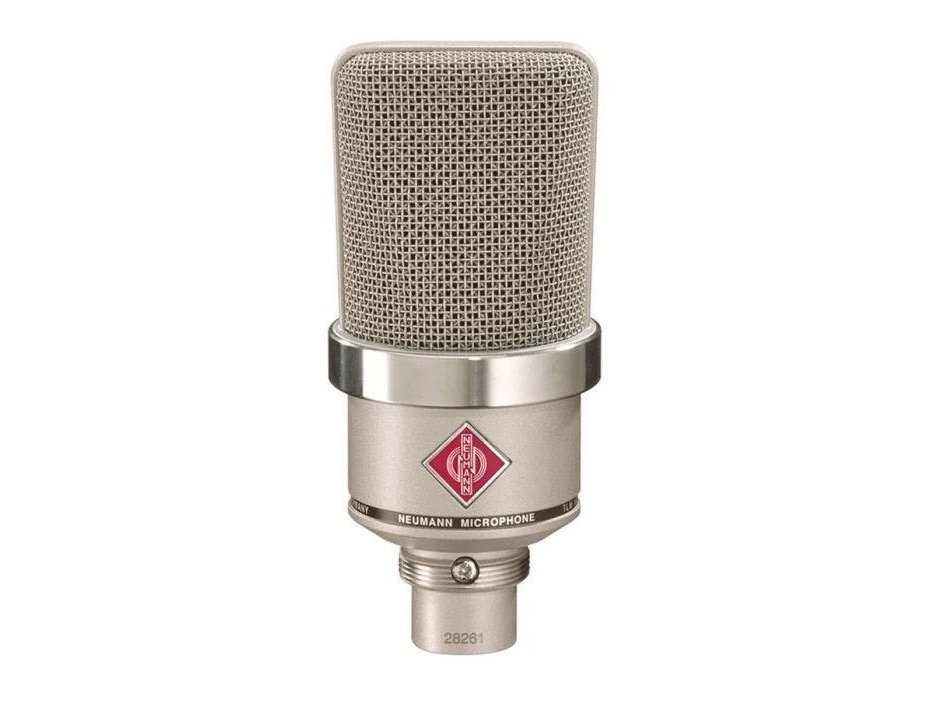
Neumann TLM 102 Condenser Microphone — Nickel, Single
Fixed cardioid large-diaphragm condenser
The Neumann TLM 102 is a compact large-diaphragm condenser microphone with a fixed cardioid pickup pattern for recording vocals and instruments. This listing is the nickel-finish single microphone, identified by Neumann catalogue number 008626. It is not the black 008627 version or the separate Studio Set supplied with an EA 4 shock mount. The standard nickel package includes the SG 2 swivel mount. Neumann specifies a frequency range of 20 Hz to 20 kHz and a maximum sound pressure level of 144 dB at 0.5% total harmonic distortion. Its response includes a gentle presence lift above 6 kHz rather than a promise of completely flat reproduction. An integrated pop screen helps control breath noise, but does not replace suitable placement or a separate pop filter when needed. The microphone uses a three-pin XLR connection and requires P48 phantom power, specified as 48 V plus or minus 4 V. A compatible microphone input, cable, support stand and recording system are separate requirements. The cardioid pattern favours sound from the front; it does not remove room reflections or background sound. It is not a USB microphone or a standalone recorder.
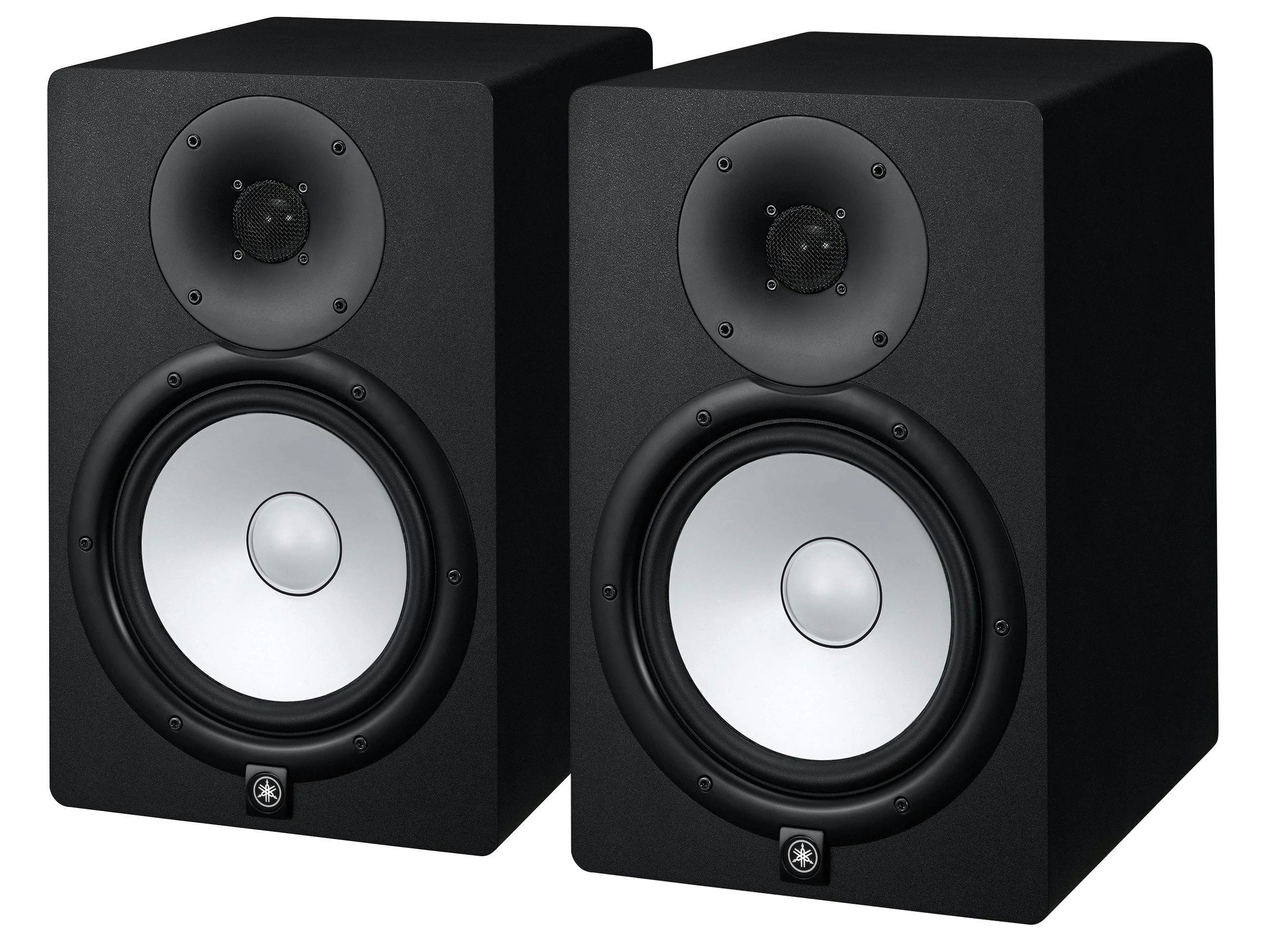
Yamaha
Yamaha HS8 Matched Pair Studio Monitors — Black
Two black powered studio monitors
The Yamaha HS8 matched-pair package contains two black powered studio monitors for a stereo monitoring setup. Each cabinet combines an eight-inch cone woofer with a one-inch dome tweeter and separate amplification for the low- and high-frequency drivers. Yamaha specifies 120 W output power per monitor, split into 75 W for the woofer and 45 W for the tweeter. This is not a claim of 120 W for the whole pair or an invented peak-power rating. Each monitor provides an XLR input and a quarter-inch phone input, accepting balanced or unbalanced signals. Rear ROOM CONTROL and HIGH TRIM switches allow low-frequency and high-frequency adjustment to suit placement. The rear bass-reflex port needs sensible clearance from walls; these controls do not replace room treatment or careful positioning. This listing uses the donor's matched-pair barcode, not the separate Google-listed single HS8 barcode. The front and rear detail photographs show one cabinet from the two-monitor package. A compatible audio source, signal cables and suitable supports are separate requirements. These are mains-powered analogue studio speakers, not battery-operated Bluetooth speakers, and they do not include a subwoofer.
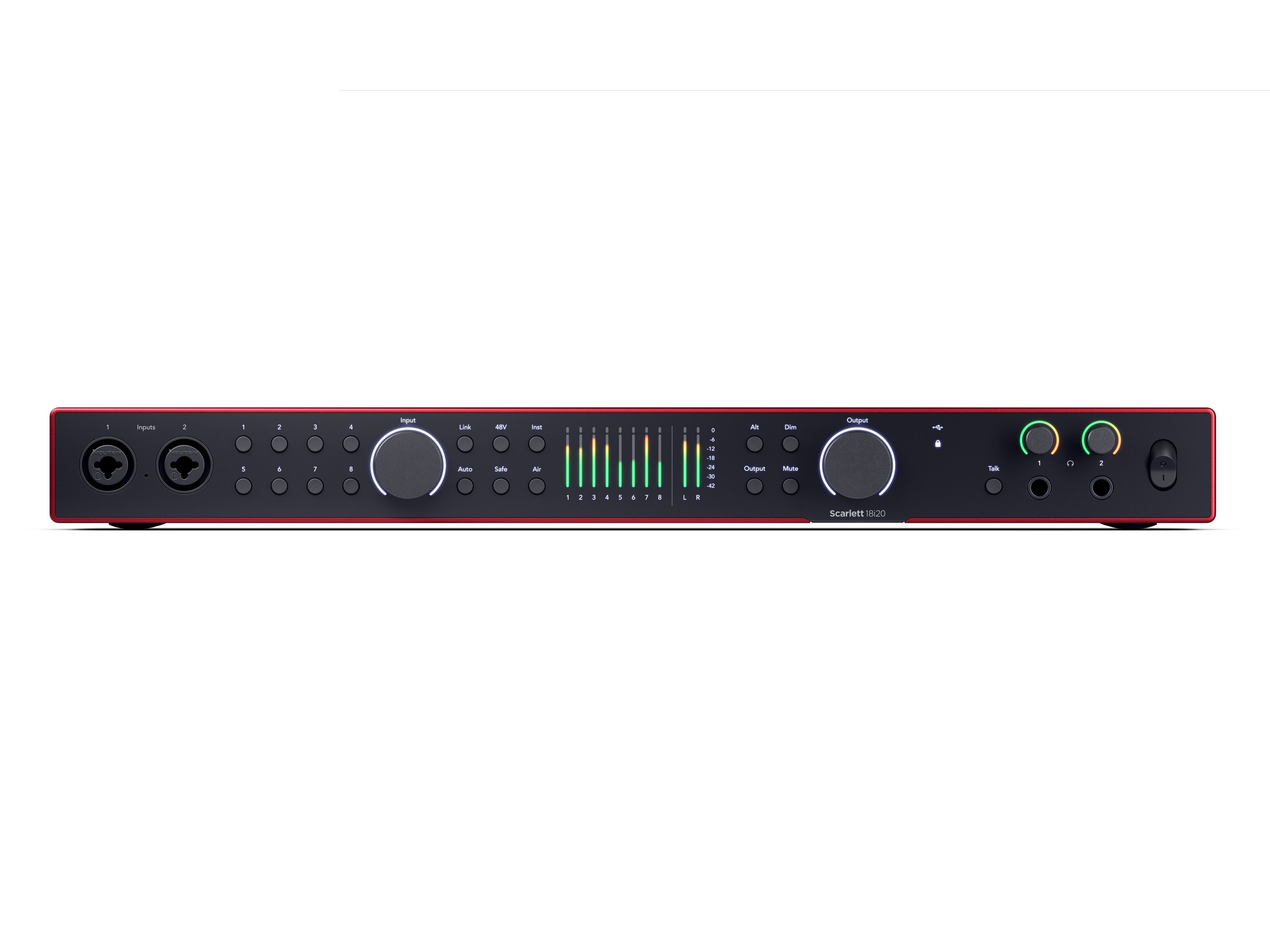
Focusrite
Focusrite Scarlett 18i20 4th Gen 26-in/26-out Audio Interface
26-in/26-out, 24-bit/192kHz
The Focusrite Scarlett 18i20 4th Gen is the largest interface in the current Scarlett range, a 1U rack-mountable USB interface with 26 simultaneous inputs and 26 outputs. It provides eight ultra-low-noise microphone preamps with sixty-nine decibels of gain range and an A-weighted equivalent input noise of minus one hundred and twenty-seven dBu. Two front-panel inputs accept microphones, line sources or instruments. Each preamp can be controlled remotely, and Auto Gain and Clip Safe help set levels and prevent clipping across all eight channels. Two Air modes, Presence and Presence with Harmonic Drive, add console-style character to vocals and guitars. Focusrite specifies a 122-decibel A-weighted dynamic range on the balanced line outputs and recording at up to 24-bit and 192 kilohertz. There are ten line outputs including alternative speaker switching, two headphone outputs and a built-in talkback microphone. Two ADAT inputs and outputs add up to sixteen channels at 44.1 or 48 kilohertz, alongside S/PDIF, MIDI and word clock connections. The unit uses an external power supply rather than USB bus power, measures 442 by 46.55 by 259.73mm and weighs 3.304kg. Focusrite's software bundle, including the Hitmaker Expansion, is included.
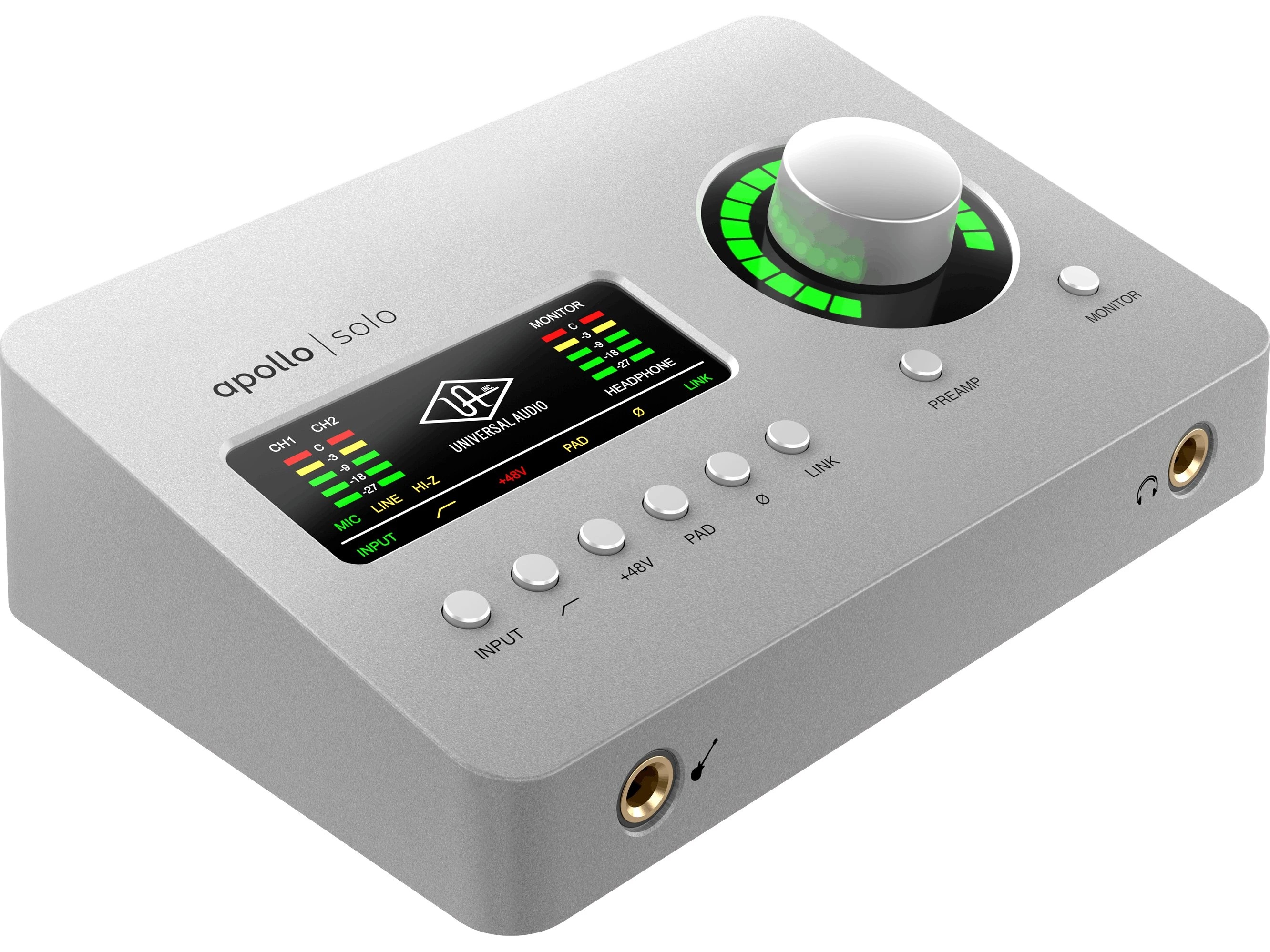
Universal Audio
Universal Audio Apollo Solo Heritage Edition — Thunderbolt 3
Two Unison microphone preamps
The Universal Audio Apollo Solo is a compact desktop recording interface for a compatible Thunderbolt-equipped computer. Two Unison microphone preamps support recording with compatible UAD preamp emulations, while onboard UAD processing allows supported effects to be used during tracking. Its two-input, four-output configuration includes headphone monitoring, and Universal Audio specifies conversion at up to 24-bit/192 kHz. This listing is the Thunderbolt 3 Heritage Edition, not the separate USB model. The rear connection and donor-bound barcode identify that version. A USB-C-shaped computer socket is not sufficient on its own: the host connection must support the required Thunderbolt capability. Universal Audio lists compatible Mac and Windows Thunderbolt 3 systems, and describes this model as powered through its Thunderbolt connection. The Thunderbolt 3 cable is sold separately. Software offers vary with eligible hardware, registration and the manufacturer’s current terms; no temporary promotional plug-in bundle is guaranteed here. Microphones, instruments, headphones and a computer are separate purchases. This is an audio interface rather than a standalone recorder.
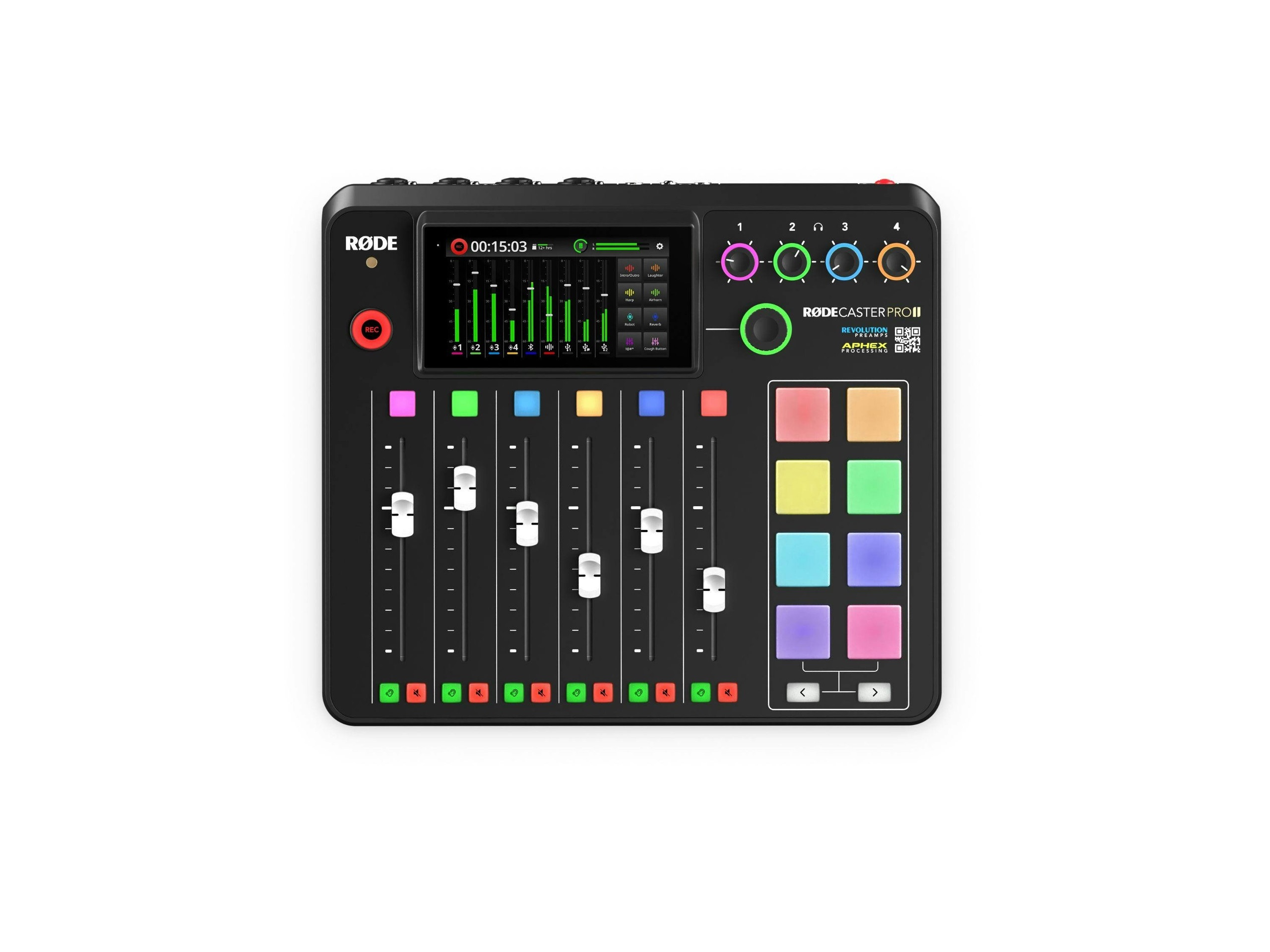
RØDE
RØDE RØDECaster Pro II Audio Production Console — Black
Four XLR/TRS combo inputs with up to 76 dB preamp gain
The RØDECaster Pro II is a desktop audio production console for podcasting, streaming and music recording. Four XLR/TRS combination inputs accept microphones, instruments or line-level sources, with Revolution preamps offering up to 76 dB of gain. Its mixer has nine assignable channels controlled by six physical faders and three virtual faders; this is not nine physical microphone inputs. Eight programmable SMART pads with bank switching can trigger sounds, effects and mixer actions. Built-in APHEX processing and onboard effects provide tools for shaping individual sources and the main mix. Stereo or multitrack recordings can be made to a microSD card, compatible USB storage or a computer. Two USB-C audio connections allow compatible computers or mobile devices to be connected, while Bluetooth provides another audio source. Four headphone outputs and balanced quarter-inch line outputs support monitoring. A 5.5-inch touchscreen and rotary encoder handle setup and adjustments. The console uses an external power supply, which is included; microphones, headphones, storage media and monitor speakers are not included in this standalone listing.
Genelec
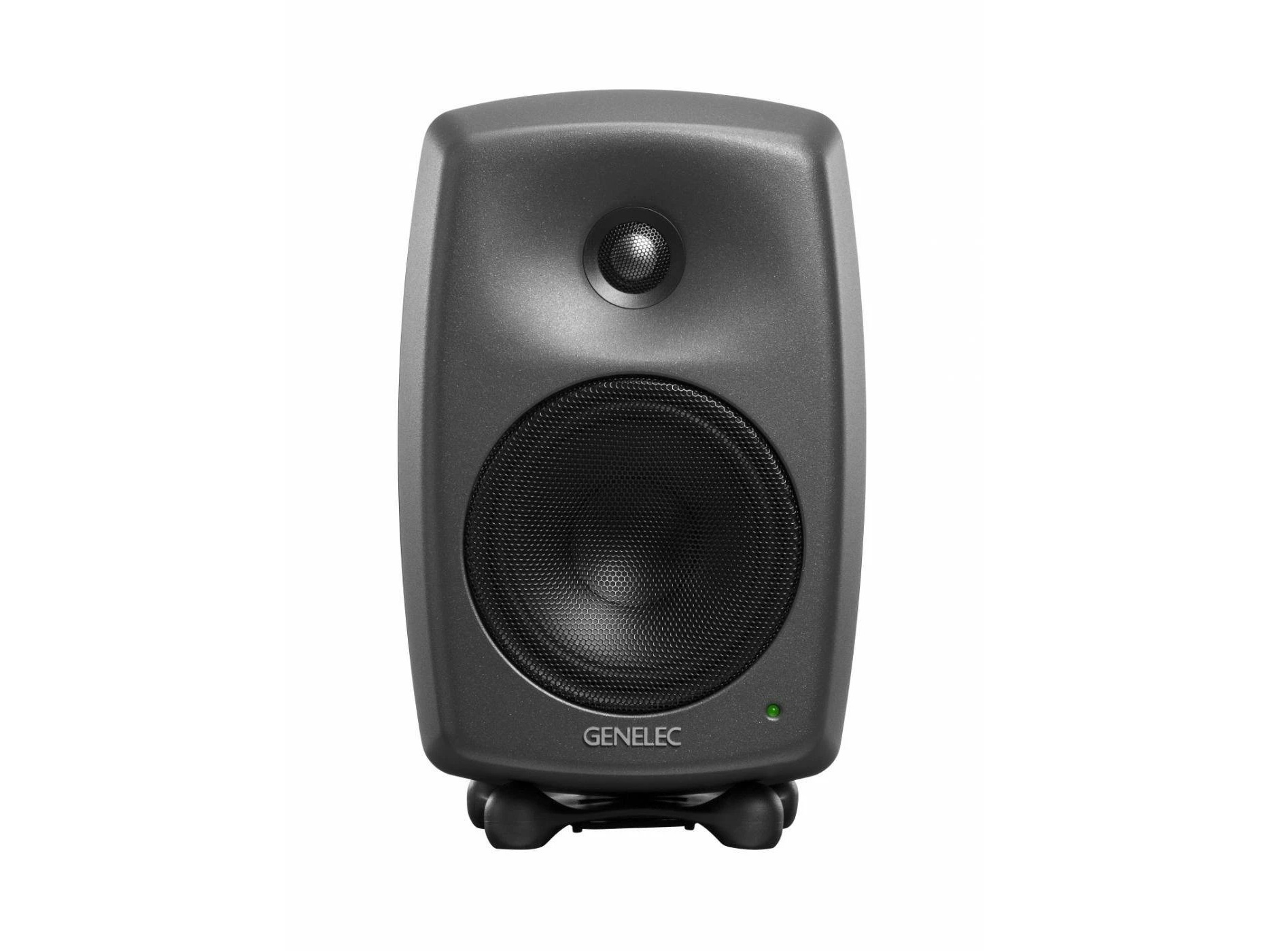
Genelec 8030C Dark Grey — single monitor
Single dark-grey 8030C powered monitor
The Genelec 8030C is a powered two-way studio monitor supplied here as one dark-grey loudspeaker. Its 130 mm bass driver and 19 mm treble driver are powered by individual 50 W Class D amplifier stages. The die-cast aluminium Minimum Diffraction Enclosure uses rounded edges, while the Directivity Control Waveguide helps shape the monitor’s dispersion around the listening position. The manufacturer publishes −6 dB frequency limits of 47 Hz and 25 kHz, with response accuracy of ±2 dB over the narrower 54 Hz to 20 kHz range. Its balanced XLR input connects to appropriate recording interfaces, mixers or monitor controllers. Built-in amplification means a separate speaker power amplifier is not required. Room-compensation controls allow the response to be adjusted for placement, and Intelligent Signal Sensing supports automatic standby. The included Iso-Pod support provides isolation and angle adjustment. This is the C generation, confirmed by the product-bound listing and rear model label rather than inferred from the abbreviated 8030 page title. The 299 mm overall height includes the Iso-Pod; a stereo monitoring system requires two units.
TASCAM
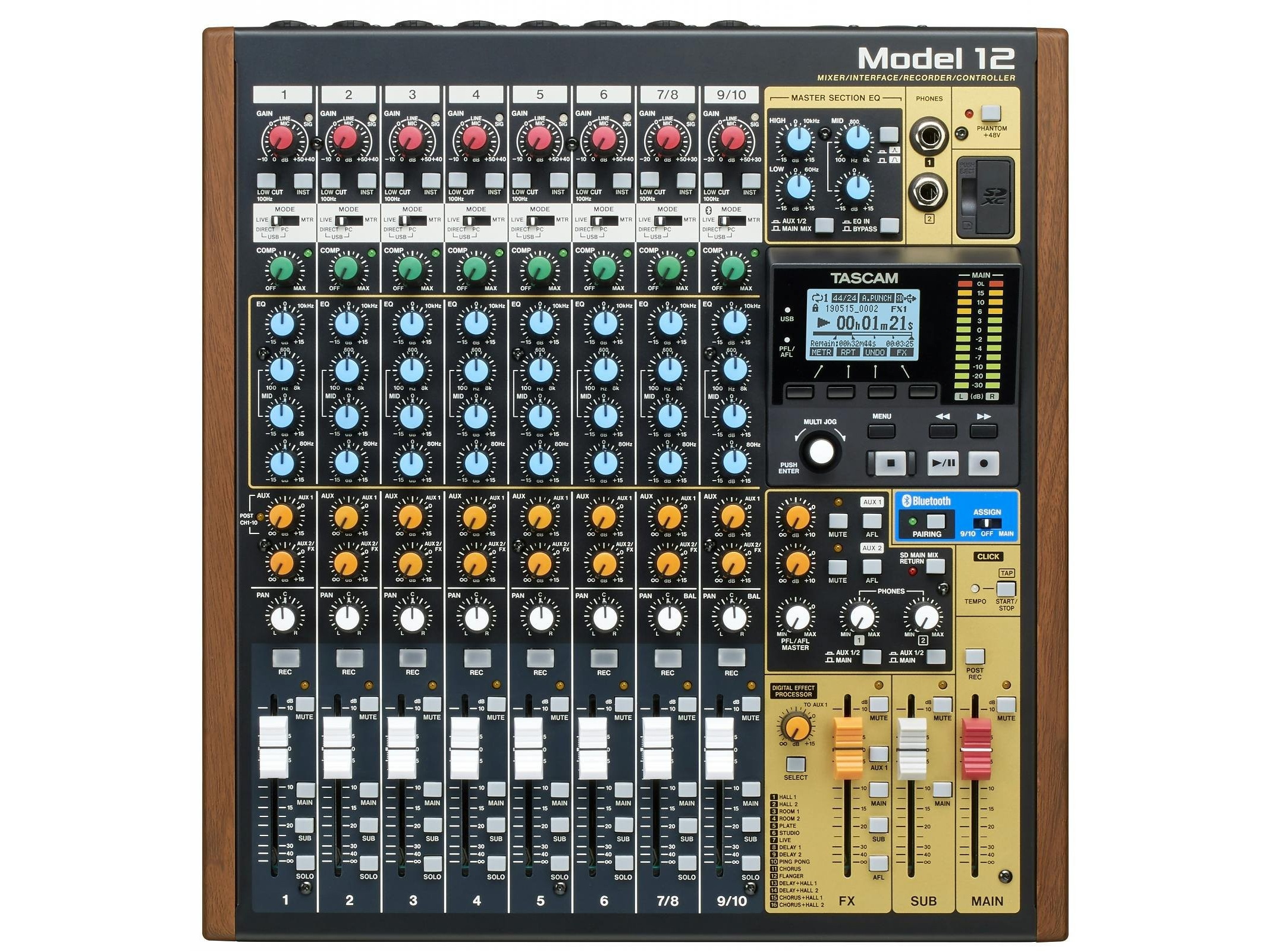
TASCAM Model 12 Mixer, Recorder & USB Audio Interface
Ten analogue inputs: six mono and two stereo channels
The TASCAM Model 12 combines an analogue-style mixing surface with standalone multitrack recording, a USB audio interface and DAW control. Its ten analogue inputs are arranged across six mono and two stereo channels, with eight XLR microphone inputs and switchable 48 V phantom power. The internal recorder can capture ten input tracks plus the stereo main mix to an SD card, creating up to twelve tracks without a computer. Recording is available as 16-bit or 24-bit WAV at 44.1 or 48 kHz; up to ten tracks can be played back simultaneously. Connected to a compatible computer, it operates as a twelve-input, ten-output USB audio interface and supports HUI/MCU DAW control. One-knob compression, channel equalisation and an onboard effects processor provide sound-shaping options. MIDI input and output, Bluetooth audio, a smartphone connection and dual headphone outputs support different production setups. The included mains adaptor powers the mixer; it is not a battery-operated recorder.
Shure
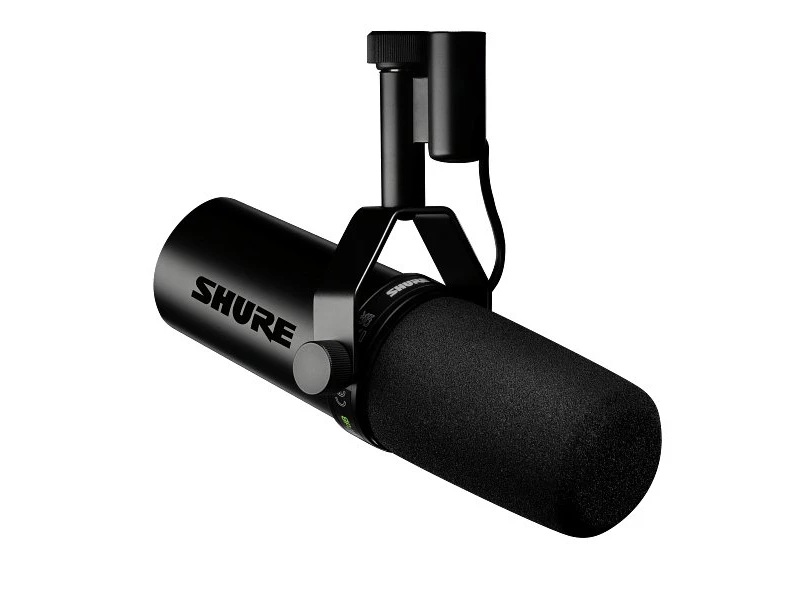
Shure SM7dB Dynamic Vocal Microphone — Black
Cardioid dynamic microphone with analogue XLR output
The Shure SM7dB is a cardioid dynamic microphone for spoken-word and vocal recording, with an analogue XLR output for connection to a microphone input. Its distinguishing feature is a built-in preamp, rather than a USB interface. Rear switches select an additional 18 dB or 28 dB of gain, helping match the microphone’s output to the recording chain without adding a separate inline booster. The preamp needs 48 V phantom power from a compatible interface or mixer. A bypass switch removes that active gain stage, returning the microphone to passive operation. This distinction matters when choosing an input: the microphone remains dynamic even though its optional preamp uses phantom power. Bass roll-off and presence controls allow the response to be adjusted at the microphone. A yoke mount provides angle adjustment, while the foam windscreen and internal shock isolation help manage breath and handling noise. The cardioid pattern favours sound arriving from the front; it does not eliminate room noise or replace acoustic treatment. This is the SM7dB, not the original SM7B or a USB recording microphone. A suitable recording interface, support stand and recording system are separate requirements.
RØDE
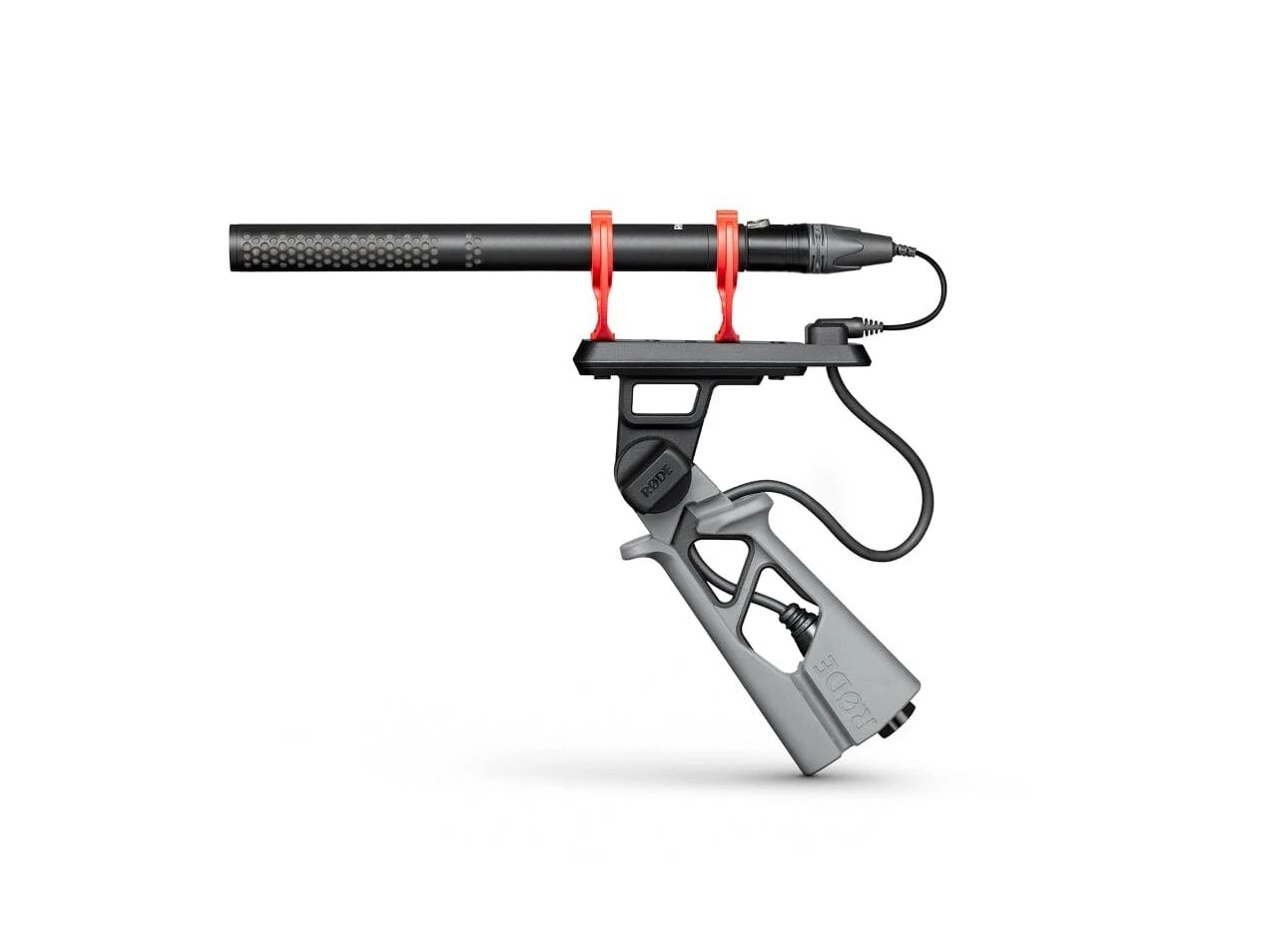
RØDE NTG5 Shotgun Microphone — Location Recording Kit
Supercardioid RF-bias shotgun condenser
The RØDE NTG5 Location Recording Kit combines a compact shotgun condenser microphone with a pistol-grip mounting system and wind protection for location sound recording. Its supercardioid pickup pattern is directional, favouring the source in front of the microphone. It is an analogue XLR microphone, not a USB recorder or a wireless system, and requires a compatible recorder or microphone input supplying 48 V phantom power. RØDE specifies an RF-bias condenser design, a microphone weight of 76 g and a length of 203 mm. The stated frequency range is 20 Hz to 20 kHz; the separately specified response is 80 Hz to 20 kHz within plus or minus 3 dB. These figures should not be confused with a switchable low-cut filter. No onboard pad or filter switch is listed in the official specification sheet. This NTG5KIT offer includes the WS10 windshield, PG2-R pistol grip, PG2-R Pro cable and ZP1 pouch described in the manufacturer's kit information. A boom pole, recorder and additional recording equipment are separate requirements. The included wind protection helps manage outdoor wind noise but does not guarantee silent recordings. Positioning, gain settings and the recording environment still affect the result.
Focusrite
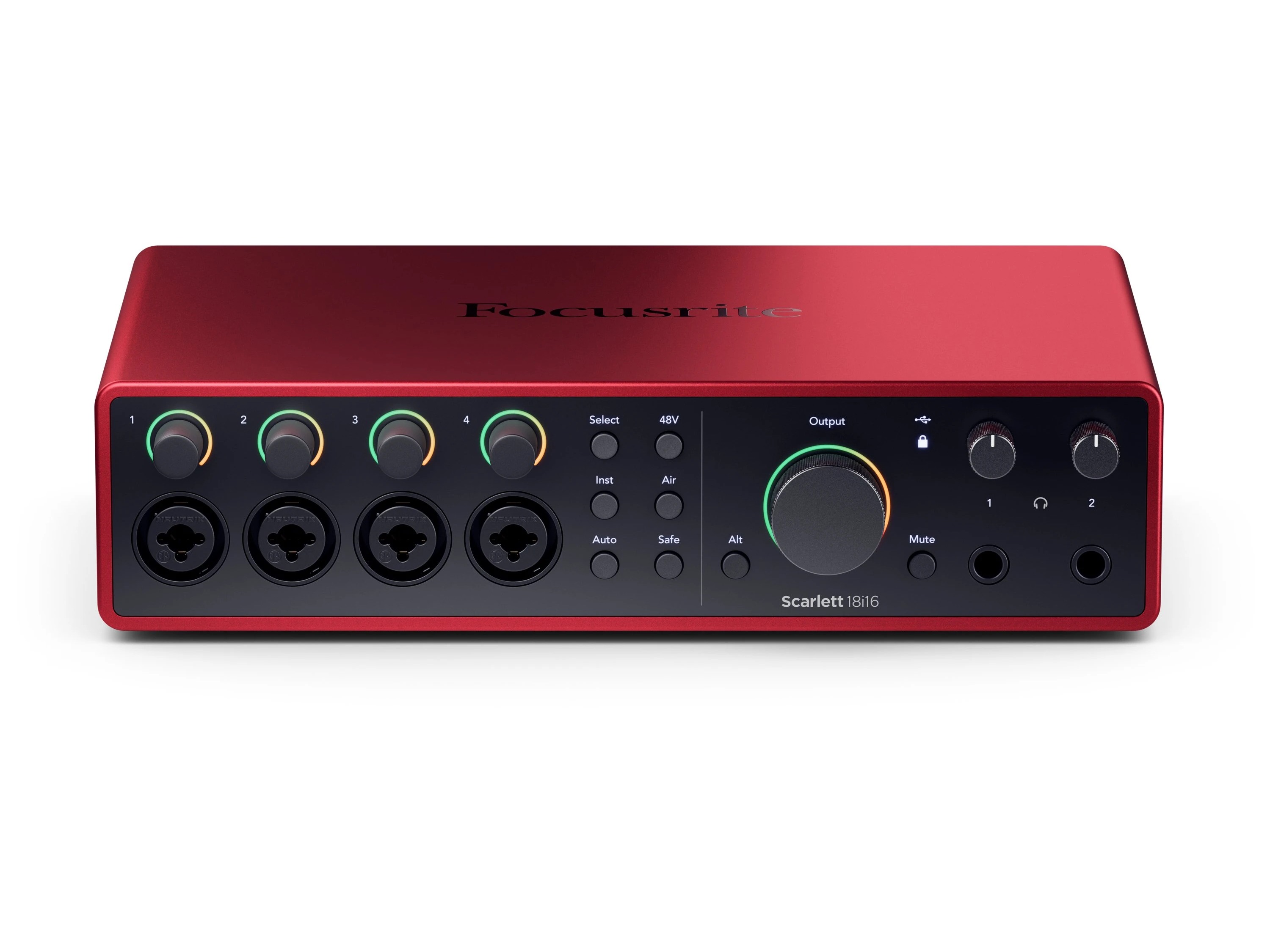
Focusrite Scarlett 18i16 4th Gen USB Audio Interface
Four remote-controllable mic preamps with 69dB gain
The Focusrite Scarlett 18i16 4th Gen is a USB-C audio interface for home and project studios that need more inputs than a desktop two-channel unit. It has four of Focusrite's ultra-low-noise mic/line preamps with a 69dB gain range, which can be adjusted remotely from the Focusrite Control 2 software, while Auto Gain sets recording levels and Clip Safe lowers the gain automatically if a signal is about to clip. Two re-engineered Air modes add the brighter, console-style character Scarlett users know. Inputs 1 and 2 accept guitars and basses directly, and four further line inputs suit synths and drum machines. Optical ADAT adds up to eight extra inputs and outputs and S/PDIF two more, and MIDI in and out sockets let the interface control external MIDI gear. Each set of outputs—monitors, two headphone outputs and line outputs—can carry its own mix, and alternate monitor switching makes it easy to compare two pairs of speakers. Focusrite quotes up to 122dB of dynamic range on the line outputs, with recording at up to 24-bit/192kHz and a Loopback feature for capturing computer audio.
MOTU
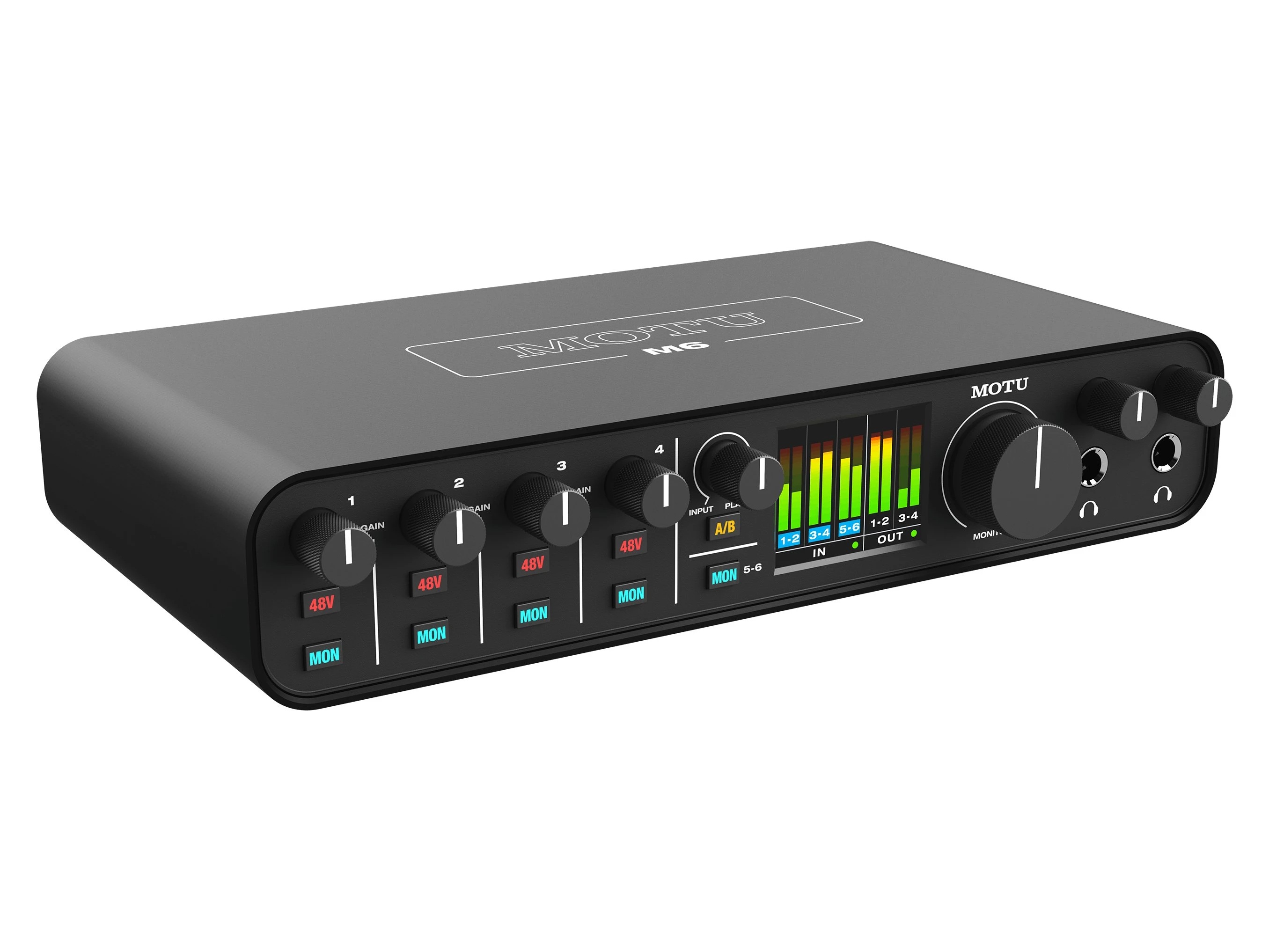
MOTU M6 USB-C Audio Interface
Four mic/line/instrument combo inputs plus two line inputs
The MOTU M6 is a six-input, four-output USB-C audio interface for recording and monitoring with a compatible computer. Four combination XLR/TRS inputs accept microphones, line sources or high-impedance instruments, each with its own preamp control and phantom-power switching. Two additional balanced line inputs complete the six analogue inputs; they are not extra microphone preamps. Four balanced TRS line outputs, two headphone connections with independent volume controls, and MIDI input and output support a range of studio setups. Hardware direct monitoring allows live inputs to be heard without routing them through software first. The monitor-mix control balances those inputs against computer playback, while A/B switching supports comparison between two connected monitor systems. The M6 supports sample rates from 44.1 to 192 kHz. Its driver provides loopback channels for routing computer audio into recording or streaming software. USB-C hosts can supply bus power; other hosts, including USB-A connections, require the included 15 V DC power adapter. Speakers, microphones and instruments are separate purchases.
Genelec
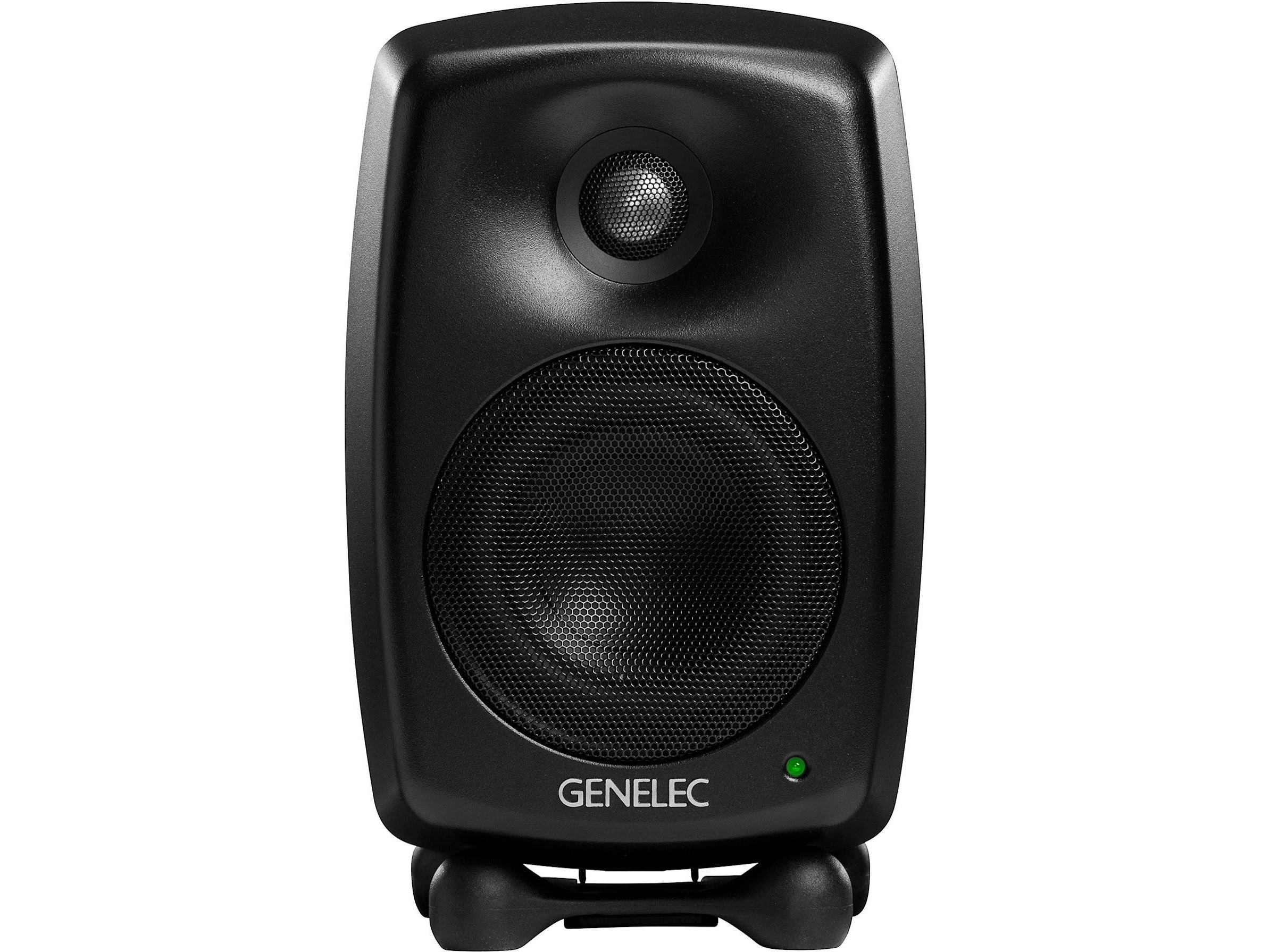
Genelec 8020D Black — single monitor
Single black powered studio monitor
The Genelec 8020D is a compact powered studio monitor supplied here as one black loudspeaker. Its two-way design combines a 105 mm bass driver with a 19 mm treble driver, each served by a separate 50 W Class D amplifier. The rounded die-cast aluminium cabinet and Directivity Control Waveguide form part of the monitor’s acoustic design, while the included Iso-Pod support allows its listening angle to be adjusted. Genelec specifies a frequency range of 56 Hz to 25 kHz at the −6 dB limits and response accuracy of ±2.5 dB from 62 Hz to 20 kHz. These are different measurement ranges and should not be combined into a single flat-response claim. A balanced XLR input accepts audio from suitable interfaces, mixers and monitoring controllers. Rear-panel room-compensation controls help adapt the monitor to its placement. Intelligent Signal Sensing provides an automatic standby function, rather than a wireless audio connection. Measuring 242 mm high with its Iso-Pod, the monitor suits spaces where a small cabinet is useful. A stereo setup requires two monitors; the price shown is for one unit.
Tascam
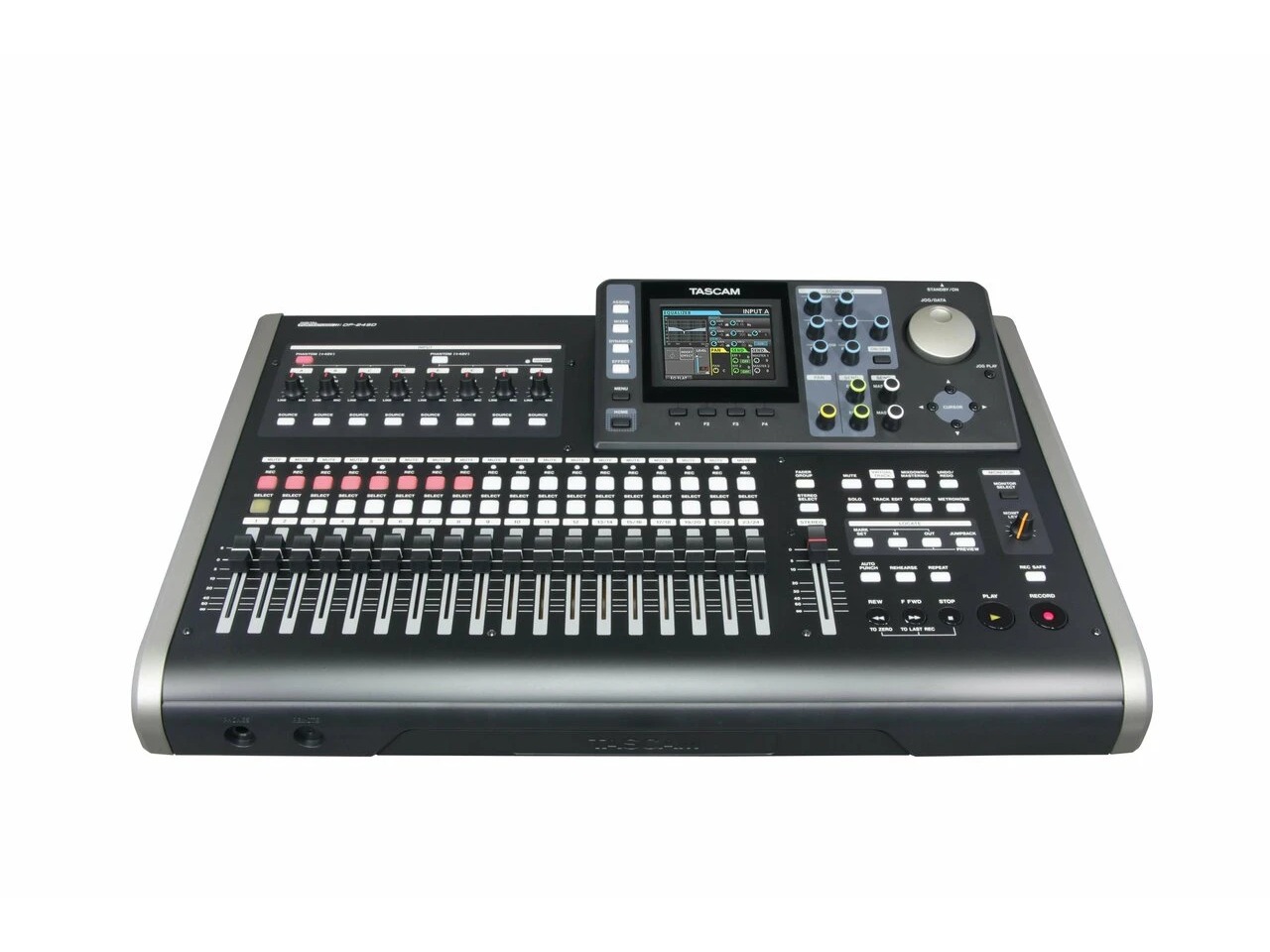
Tascam DP-24SD 24-Track Digital Portastudio
8-track simultaneous recording, 24-track playback
The Tascam DP-24SD is a self-contained 24-track digital Portastudio for recording, mixing and mastering without a computer. Eight XLR/TRS combo inputs with switchable phantom power let you record up to eight sources at once, such as a full drum kit or a band, and input H can be set for a guitar or bass. Playback runs across 24 tracks—twelve mono and six stereo—with 19 track faders and a master fader so every track can be reached without fader layers. Each input and track has its own 3-band semi-parametric EQ, and twelve colour-coded encoders work with the colour LCD for EQ, pan and effect sends. Dynamics for the inputs, guitar multi-effects, mix-down reverb, delay and chorus, and mastering tools including a multi-band compressor, EQ and normaliser are built in, along with track bounce and eight virtual tracks per track for alternate takes. Recordings are made at 44.1kHz or 48kHz in 16-bit or 24-bit to SD/SDHC cards of up to 32GB, and files can be transferred to a computer via USB 2.0. Outputs include stereo RCA, two effect sends and a 70mW-per-channel headphone output. Tascam lists the weight as 6.2kg.